
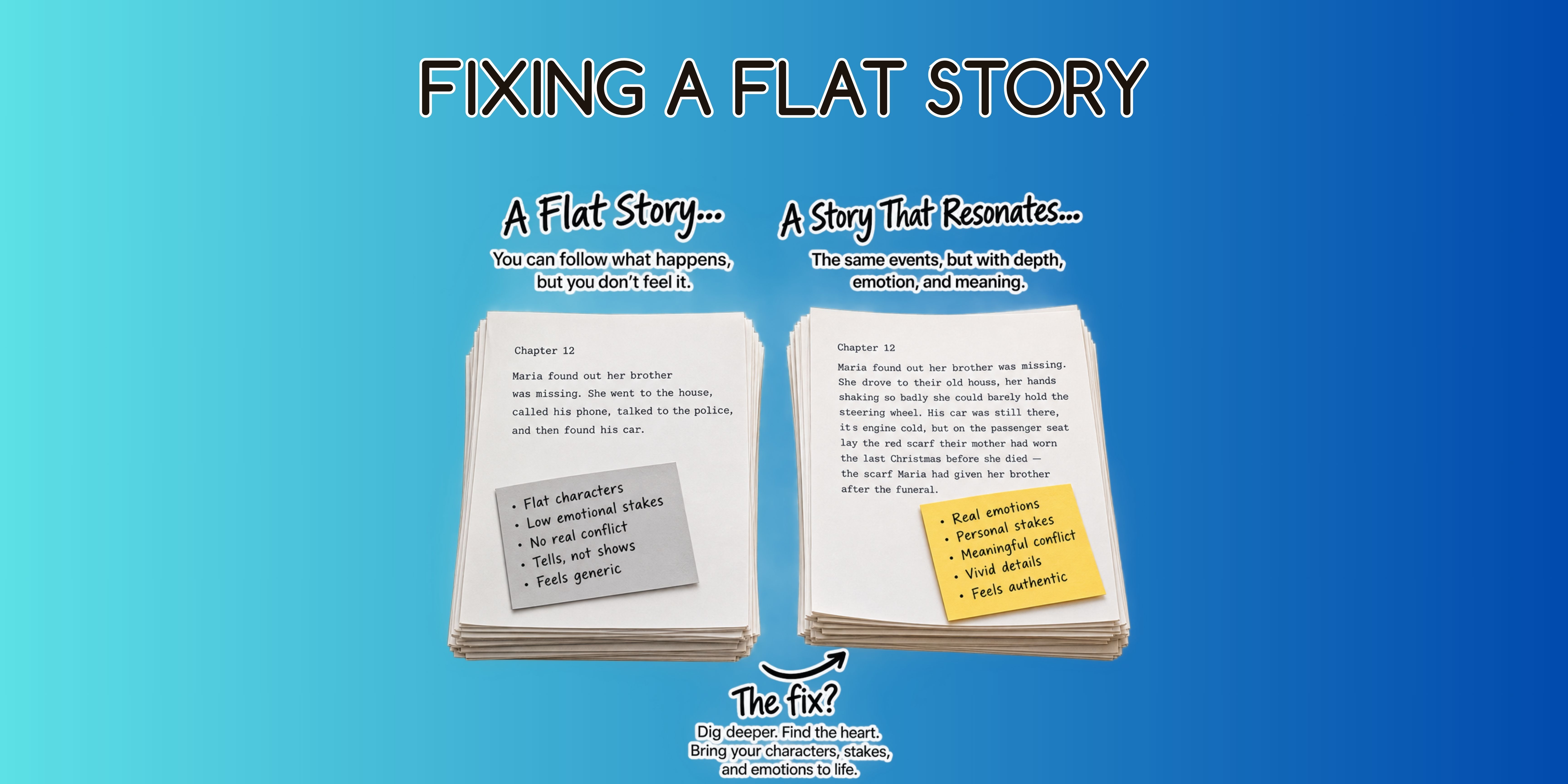
Fixing a Flat Story
When your story feels flat, of course you want to fix it. But how do you fix a flat story if you don’t know what’s causing it to feel that way?
There are a number of reasons a story can feel flat, so the best way to remedy a flat story is by first determining why it feels flat.
Here is a list of the kinds of things that can make your story feel flat.
Flat Characters: If your character doesn’t come across as complex, contradictory, or emotionally alive, they will feel flat and predictable. The remedy for this is to ensure that you make your characters complex and compelling. Give them strengths and weaknesses, skills and areas of opportunity, contradictory thoughts and emotions. In other words, make them multi-faceted, just like real people.
Flat Stakes: When there is something at risk, but it isn’t clear why that matters to your protagonist, the story stakes can feel flat to your readers. Give your characters meaningful goals, make the stakes matter deeply to your character, and then find ways to show the reader why they matter.
Flat Conflict: If the conflict and barriers that you put in the way of your character don’t force them to make meaningful choices, the story conflict will come across as flat. Obstacles without meaning are just hurdles to jump over. Meaningful conflict derives from obstacles that force the character to change, whether that is a change in course, a change in tactics, or a change in their thinking.
Flat Scenes: Flat scenes are those in which nothing meaningful shifts. No matter how scintillating your dialogue, no matter how fascinating your description, if there is no shift in the scene, then it’s probably not important enough to include in the story.
Flat Emotions: This is one of those places where the advice “show don’t tell” is your best friend. Just telling us how your character feels doesn’t allow us to feel the emotions that they’re going through. Showing the characters’ emotions through their interiority, perception, visceral sensations, sensory details, and the choices they make is the best way to ensure that we are on the journey with them and experiencing the emotions alongside them. That’s just good old-fashioned brain science.
Flat Prose: Prose that conveys information but doesn’t create story-specific mood, tone, imagery, or provide us with emotional texture will come across as flat. This isn’t just about vivid description, but how that description is conveyed through character viewpoint and lens.
Flat Pacing: This is when the story moves and things happen, but the things that are happening aren’t building tension or momentum or creating curiosity in the reader. As a story moves forward, conflict should increase, the barriers that the character faces should become more challenging, tension should ramp up much like the rise of a roller coaster till we reach the point where things come to a head, which is why we called the high point of story the climax.
Flat Arc: Just like with conflict, if things are happening to the character, but the character doesn’t meaningfully change or learn anything along the way, you can end up with a flat arc. The caveat here is that there are stories in which we may intentionally want our character to have a flat arc. These are stories in which a character has every opportunity to learn but does not and ends up right basically where they started. We tend to see this more in literary fiction than we do in genre fiction.
Flat World: This is especially a pitfall in speculative fiction. It happens when an author has built an incredible world with imaginative terrain, well-developed political systems, diverse costuming, and detailed maps, but the way all of that tremendous worldbuilding is expressed on the page doesn’t feel live in or connected to the characters in any way. No matter the setting, having your characters interact with their world in a way that feels natural to them is important in ensuring your world does not come across as flat.
Fixing a flat story starts with understanding why it feels flat in the first place. Knowing the cause is half the battle.
* * *
For more information on Book Coaching, check out my FAQ page.
If you’re interested in what I write, check out my Author site.
And if you write or want to write children’s books, give the Coaching KidLit podcast a listen.