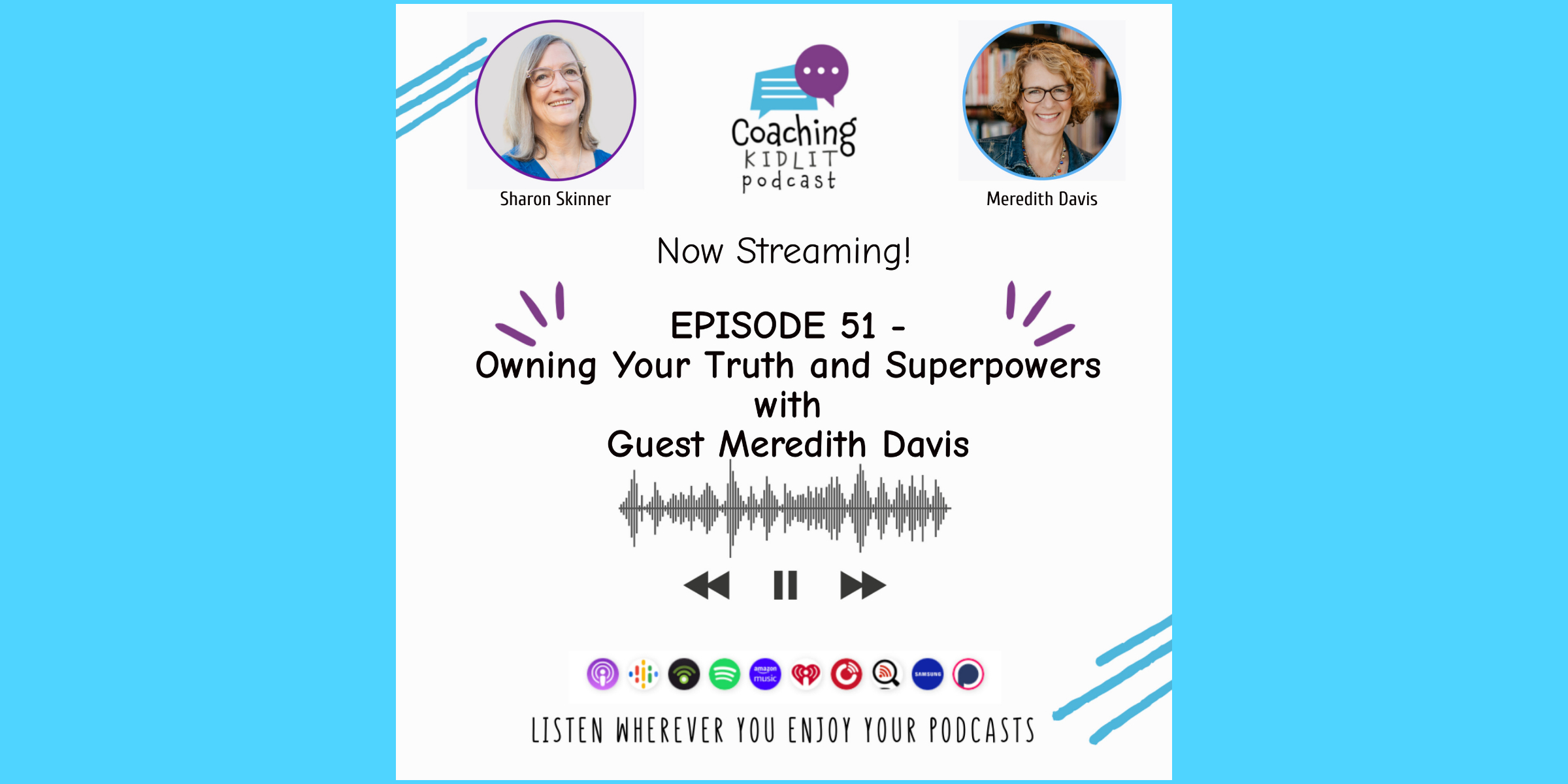
Coaching KidLit Episode 51: Owning Your Truth and Superpowers Guest Meredith Davis
Host Sharon Skinner chats with author Meredith Davis about her writing journey, the power of connections in publishing, and the importance of discovering and owning your unique superpowers as a writer. They discuss Meredith’s books, including The Minor Miracle and Her Own Two Feet, and explore how truth and personal history inform fiction. The episode offers practical advice for writers on finding their strengths, building writing community, and using personal experiences to create layered, authentic stories for young readers, and delves into the importance of owning one’s creative gifts, while offering actionable exercises for writers to discover and lean into their individual superpowers.
Connect with Meredith Online:
Website: https://meredithldavis.com
Substack: Author with a Kidlit Crush
Instagram
FaceBook
Topics Covered
- Superpowers, Stories, and Connections
- Gravitons: Science Meets Fiction
- Truth, Trust, and Consequences
- Truth in Stories Connects Us
- Writing, Learning, and World-Building
Books Mentioned
The Minor Miracle (Amazing Adventures of Noah Minor series, book 1) by Meredith Davis
The Minor Rescue (Amazing Adventures of Noah Minor series, book 2) by Meredith Davis
Her Own Two Feet: A Rwandan Girl’s Brave Fight to Walk by Meredith Davis
Listen:
Transcript:
[00:00:00] Sharon Skinner: Welcome to coachingkidlit.com, a podcast about writing and publishing. Good KidLit. We dig into various aspects of writing craft through a KidLit lens and provide inspiration and clear actionable items to help writers like you move forward on their KidLit writing journeys. I’m Sharon Skinner, author accelerator, certified book coach and author of Speculative Fiction and KidLit, including picture books, middle grade and young adult.
[00:00:29] Hello listeners today we have another author, guest for you. Meredith Davis is the author of The Minor Miracle and the Minor Rescue Books one and two in the Amazing Adventures of Noah Minor series out from WaterBrook in 2024 through 2025, and she’s the co-author of Her Own Two Feet, A Ruandan Girls Brave Fight to Walk. That came out from Scholastic in 2019. She once worked in an independent children’s bookstore, started the Austin chapter of S-C-B-W-I and earned her Master’s of Fine Arts in Writing for children and young adults at VCFA. Her superpowers include reading, grandmothering, and finding Ways to fit more books in her Austin, Texas Home.
[00:01:13] Welcome to the show, Meredith.
[00:01:15] Meredith Davis: Aww, thank you. It’s such a pleasure to be here. I really am excited for this conversation.
[00:01:19] Sharon Skinner: I am looking forward to talking to you. So you actually wrote a book in 2019 and then you had a little space between that and the Noah Minor adventures. You wanna talk a little bit about your writing journey?
[00:01:34] Meredith Davis: Yeah, sure. I’d love to. So I actually started writing a really long time ago, and you mentioned that I started the Austin chapter of S-C-B-W-I. And that was kind of the beginning of my writing journey really. I decided I wanted to write children’s books about the same time I was working at this independent children’s bookstore and just really learning the ropes about children’s books.
[00:01:53] It was, amazing. It was called Toad Hall. And so I just skyrocketed in what I was learning at the time and was writing and submitting, also having kids had three kids, and went on. I kind of kept hitting a brick wall, was having trouble getting an agent. Knew I wanted to publish, was seeking that contract and just was not happening for me.
[00:02:11] And so I got my MFA at V-C-F-A. I figured if I really took myself seriously and put the money and time into getting that master’s, then It was gonna happen and it did. So after that, I signed with my agent. The very first project that we went out on was actually the minor miracle, but it didn’t sell.
[00:02:29] And so we went out for a couple of rounds. Then we tried something else for a couple rounds and. All while that was happening, life was happening. So my kids were getting older, and about that time we, brought a child into our home from Rwanda who needed Clubfoot surgery. And so she lived with us for a year while she was having this surgery.
[00:02:44] And in my mind, that was just a very separate thing that was happening. It wasn’t really related to my writing, but it just so happened I had. Signed with my agent while I was with, Rebecca while she was living with us. And my agent suggested, Hey, wouldn’t that be a great story? And I was like, well, yeah, it’s a great story.
[00:03:00] I blogged about it. People were really interested in it, but it was narrative nonfiction. And I didn’t write narrative nonfiction. I wrote middle grade. And so I, resisted and she kept kind of pushing. And so eventually I flew to Rwanda. I talked to Rebecca and I said, Hey, do you wanna write a book together?
[00:03:16] So that first book. Did not look anything like I thought my first book would look like. but Scholastic bought it and it did great. It was accepted into their book fairs. It sold over 150,000 copies, and it was just really, really exciting. So, while we were doing all of that in 2019, it came out, there was COVID, of course.
[00:03:34] I started working again on some of these other manuscripts that I had, and one of those was the Minor Miracle. And just so happened that while I was working on her own two feet with Rebecca, I met a woman who was a teacher who was also, from Nigeria. She was Nigerian American American and I asked if she would be one of my sensitivity readers.
[00:03:51] And she was a teacher at the time. Well, that woman went on to become an editor at WaterBrook and she’s the one that ended up buying the Minor Miracle and the Minor Rescue. So it’s just so cool how those connections came together. So that, first book was bought, in 2023.
[00:04:07] It came out in 2024. And then the 2025 is when the minor rescue came out. And I’m back on the writing trail, I’m working on my next books, you know, and you just never know what the connections are that are gonna lead you to that next book.
[00:04:19] Sharon Skinner: Yeah, so. We were talking before we even got on the podcast a little bit about connections so that’s a great story that you ended up making that connection and then remaking that connection later when that book was bought by that editor.
[00:04:32] Meredith Davis: That’s exactly right. And I had no idea at the time, it was just somebody who was, she’s actually credited in the back of her own two feet. I thanked her for being one of my readers for her own two feet. And so I just think that’s really cool that those books are somehow strangely connected, even though they’re very different in the way.
[00:04:47] Although it’s also interesting that, I have these really different looking books on my shelf now. I’ve got these fiction middle grade books about kids who find out they have a superpower. And then I’ve got Rebecca, but I like to think that she kind of had her own superpower and it actually dovetails nicely.
[00:05:03] ’cause I do author visits and I talk to kids and I always love to ask them like, what’s your superpower? And you know, I think there’s such a, huge mythology and fascination with superheroes and there’s so many movies that come out about superheroes. And so we often kind of overlook those.
[00:05:19] Extraordinary ordinary things inside of us. And so like the, the trajectory, I know we’re gonna talk about it in a minute, but with a minor miracle, Noah finds out that yes, he can manipulate gravity and that’s an amazing superpower, but at the end of the day, so are his friendships. And so I talked to the kids, I’m like, what do you have that you’re not even noticing?
[00:05:37] That actually is super powerful. Well, Rebecca was like that. looking at her, you would’ve never thought that this girl was strong. And so we have this phrase in the book strong like a butterfly. You can’t tell how Strongs. Someone is by the way that they look just like a butterfly is strong, but they’ve got these fragile little wings.
[00:05:52] They can migrate 3000 miles. And Rebecca left her home, left. Her family flew 3000 miles across the ocean to live with strangers while she had surgery on her club feet, which is incredible. but I ask kids, I’m like, how are you strong like a butterfly? And no, you’re never gonna get on a plane and fly across the ocean and have surgeries and live with strangers in a, country where you don’t speak the language.
[00:06:13] But do you have to learn new things? Is that in some way, like what Rebecca had to do? And so I kind of draw it out of them. I’m like, if you’ve ever had to practice and be patient again, that’s what Rebecca had to do when she learned how to walk again on her turn straight feet. So that superhero theme is really tied up in both of those books, even though they, by all appearances seem very different.
[00:06:33] Sharon Skinner: I love that you talk about the superpowers that we have that we may not notice. We talk a lot about the zone of genius, in the same way. what is that thing that you have that is so special to you and you’re so good at it and you’re so passionate about it that it, is like a superpower.
[00:06:52] Meredith Davis: Yeah, I love that. And I can imagine that a lot of writers would say writing is their first thing, and I think that’s true. Like that makes us unique amongst the population that we relate to the world with words and maybe can sometimes say things better with the written word than we can with our. Spoken word even, but I like to even like dive deeper with that when I’m talking to the writers and be like, what is your passion outside of writing and how does that worm its way into your writing?
[00:07:16] How does it find its way? How does it influence what you write?
[00:07:20] Sharon Skinner: As a book coach and a book editor, my superpowers really are in the area of. Understanding authorial intention so that when I’m editing someone else, I get what they’re trying to do and I can help them do it better, rather than me trying to tell them how to fix or write their book.
[00:07:39] I really. Get authorial intention. I often actually edit poetry for several poets who come to me specifically because I understand that intentionality and how critical it is, especially to a short work like poetry. And I take great joy in being able to do that for people and sure the writer’s voice is what comes forward, not my editing.
[00:08:04] Meredith Davis: You’re really empowering them by seeing what they can’t see in themselves, which is awesome. So that’s an awesome superpower. I love it.
[00:08:11] Sharon Skinner: Thanks. I love it too. I love doing it.
[00:08:13] Meredith Davis: That’s great.
[00:08:14] Sharon Skinner: So let’s talk a little bit about Noah and his superpowers There’s so many fun things about this. let’s start with the fact that you use Gravitons as. The way that he can move things. And that’s real science real potential physics that you’ve incorporated into the book.
[00:08:36] was something that you went in search of or did it just happen?
[00:08:41] Meredith Davis: I was so delighted when I happened upon the term gravitons. What an amazing superhero or superpower ish type word that is. So, I was fascinated by gravity. kind of as an aside, I thought I had read that like scientists didn’t entirely understand gravity and that, that there were these particles that they called gravitons, but they weren’t sure exactly how they worked and I was like, wait a second.
[00:09:02] That’s really interesting. And what a awesome thing to find when you’re writing fiction that you wanna have some sort of scientific element, but there should be some questioning about it. Because then you can just fill in the blanks however you want. And so, I did do a lot of research and I talked quite a bit actually to my husband, who is much more, science-minded than I am, and, unpacked a lot of things.
[00:09:20] We had some great conversations about it. Talked to some other people that I know that are more in the science world and then just played around with what we know and what we don’t know. And so like another element is. Super moons, which are real. And I did all this cool research about like how super moons can affect the tides.
[00:09:37] And maybe they, they say maybe some of these disasters were caused, because of the super moons, or it like had some sort of effect. I was like, okay, that’s all I need is the, maybe the, maybe is enough for me to take my imagination and run with it. so with gravitons, Noah can manipulate gravity, and I wanted there to be very specific ways that that happened.
[00:09:55] Happened. I didn’t want it to just be kind of this magic thing and so. I tried to come up with like the perfect analogy and I really wanted it to be, something that kids could relate to. So I have Noah learn how to spin gravitons into this thin rope that would connect him with whatever object it is that he’s trying to pull.
[00:10:14] The pull is actually the superpower, the first of many. powers that he’ll get. And so, everybody can relate to like having something attached to a rope and pulling on it and like tension. but with that, if there was something on a desk and you’re sitting in the chair and you have say a pen or a, cup and you’re sitting kind of far away from it and you pull on the rope and there’s space between where you are and that cup or that pen is, it’s gonna drop a little bit, right?
[00:10:39] it would drop to the floor. And so I wanted that to. Follow those physics, I wanted it to be like true to what would really happen if there was a rope attached. And so that’s something that happens. They’re still affected by the gravity of the earth. I kind of got into the weeds with it. My editor had to like, take some of it out and say, Hey, we don’t have to get too close into the minutiae of all this and how it works.
[00:10:57] But it does work for kids that have those questioning minds and say, but what about, I think I covered all of the like, what abouts for it to, work in this world
[00:11:06] Sharon Skinner: I, think you really did capture that. one of the fun aspects of that is how you made sure that each person has their own way of developing that ability to grab that thread and pull it toward them. I love how, Rodney helps by using his superpower, which is playing the trumpet how there are other ways, like the fishing analogy and things like that for Noah try figure out how to come to his own way to do things.
[00:11:35] Because I think it’s really important that kids get to understand that there’s not a single way to approach things and that their way Is just as legitimate as anybody else’s way, and you do a beautiful job of just showing that in this book without preaching it.
[00:11:52] Meredith Davis: Oh, thanks. I’m so glad you picked up on that. And I love hearing somebody else talk about my book ’cause that was certainly in my mind, but I don’t know if I could have said it quite that Well, so your superpower is very evident.
[00:12:02] Yeah. You know, I, played trumpet when I was younger, much younger.
[00:12:07] And then in, I think it was ninth grade, I switched to oboe. And one of the interesting things about the oboe is that it’s used to tune orchestra or the band you play a middle C. And so I was the one that had to tune everybody and I actually was often out of tune. So I had this little tuner that would sit on my music stand and I would watch it to make sure that the bar was just right.
[00:12:27] and It’s, funny that you picked up on that because that whole idea of a line, I really thought about that. When you’re tuning, when you have a note, when you hit it just right and then when all the other instruments hit it just right, they all come together and it is like this solid line, this note. So yeah. Where Rodney does help Noah, he’s thinking through all these things. He’s thinking of how this other person is using wool and how if you spin wool,
[00:12:50] eventually it turns into this one long thread. it’s connected to me in all my different experiences, but also I was trying to get to that truth, which you just spoke.
[00:12:59] Sharon Skinner: it’s really clearly there without being, overt. It’s beautifully done. I really appreciated that. I also really enjoyed Noah as a character. you made him fallible and gave him a lot of challenges in this book. And without the book, he has to come to a realization that what he believes is not the truth, And it takes him a while. So I enjoyed his journey and I also enjoyed his friendships with his friends, including, his friendship with Haley, especially because, they’re really best friends, but that also becomes at risk because of what Noah is going through. So I thought
[00:13:40] there was a lot of really nice layering in there of the different threads of the story, but it all thematically ties together into what do you believe about yourself, about the world, about the people in it.
[00:13:54] Meredith Davis: Yeah.
[00:13:55] I think I was really playing around with the idea of like, how do we know what is truth? Like who’s telling the truth in our world? and sometimes the truth is kind of hard to hear and so we wanna listen to the voices that just kind of tickle our fancies and build us up. And that’s not to say that those aren’t good voices, but sometimes people can do that maliciously and they can kind of be buttering you up so that they can manipulate you.
[00:14:16] and sometimes the hard. Truth that, hearing like, hey, you’re not the best, but we’ll, work with what we’ve got you don’t wanna hear that. And it can, either, crush you or it can make you push back.
[00:14:27] So, Noah has to decide, Is he gonna trust his uncle Saul?
[00:14:30] Is he gonna trust gravitas, this organization that’s offered to train him and, what’s at stake there? Because if he chooses not to trust this person, even if he’s got his misgivings, like, hmm, I’m not sure I trust that person, but if I part ways with him, there’s consequences and I may not wanna deal with those.
[00:14:46] So. Yeah, I think those are all like real life things that kids have to deal with and adults.
[00:14:51] Sharon Skinner: Meredith, we talked about my superpower. What is your superpower?
[00:14:54] Meredith Davis: Well, I think my, easy to say superpower is writing. I mean, I really do think that, like, I can say things with words on the page that I have trouble saying out loud. it helps me process and think through things. often if I can’t figure something out, I just start writing. I just start journaling.
[00:15:09] So I do think that writing can be a superpower. And so, as. Maybe trite as it is to talk to a writer and ask them what their superpower is and have ’em say writing. I will say the other one is reading, like reading transports you to other worlds, many other worlds. and if you have a love for reading, man, It’s a gift that can just take you away from wherever you’re at or help you learn. it just expands your mind continually. So I think reading and writing really are my superpowers.
[00:15:36] I wish I had something more creative to say.
[00:15:38] Sharon Skinner: No, that’s, great. But I wanna, push a little bit on that because. We’re talking a little bit about superpowers for individuals and for individual writers. and that is the easy answer. I mean, I’m a writer and I know voice is one of my superpowers when I write.
[00:15:53] And nuance, right? Word choice, like that.
[00:15:56] I have a poetry background so of course, you know, that’s gonna come into it. We all come strengths and weaknesses into this craft, into this art form. so how would you recommend that a writer who wants to develop a superpower or to identify a superpower how might they approach figuring that out?
[00:16:17] Meredith Davis: Ooh. I love, doubling down on that. I think, you know, if I were to double down, I would say like, what I’m really good at in writing, the thing that comes easy to me is finding heart. You know, like capturing an emotion, finding someone’s heart. not in a manipulative way, but like, I feel like I can move people emotionally.
[00:16:35] and how do I know that is because that’s what I hear back. Like that’s the feedback I get. And so I think it’s, if a writer’s trying to find out, well, what am I good at? Am I better at like plotting and character or setting or description or dialogue? What is it? What are people telling you?
[00:16:49] And if you don’t have people telling you, it means you’re not in a community yet. And so get into a community and share your work, whether you’re sharing your work with other writers, whether you’re doing it on a blog. I like to tell people I’ve written a Christmas letter since 1995 and I get feedback on it.
[00:17:04] I am not asking for it, but I will get a text back and they’re like, oh my gosh, the way you did this or that, or whatever. And honestly, like long before I ever had a book out, that was like my first published work and it was the thing that I was getting feedback. From, and it was
[00:17:16] kind of like a drug, it was reinforcement that yes, you are a writer.
[00:17:20] There’s something special about that. You’re getting feedback that that’s something that’s
[00:17:24] touching people. So then that turned into blogging and, letters and emails and all sorts of things before I ever got brave enough to really, start sending out manuscripts to publishers. So, yeah, I just think, what are people telling you?
[00:17:35] Sharon Skinner: That brings us connection and community. And I think when you do find community, when you are out there, say you’re looking for a critique group is to figure out who has the right superpowers to help you advance your writing while your superpowers can help them advance and level up their writing.
[00:17:53] Meredith Davis: yeah, I totally agree. I’ve been in many different critique groups over the years. Lots, of different looking ones. And you know, I think in the beginning, We were all kind of beginners and we were all like helping each other, but we were also passionate. So it was like, did you read this book?
[00:18:05] Did you read that craft book? What did you think about this? And it was really exciting to see each of us, our work growing and eventually going out there and getting published and those sorts of things. And now, you know, it’s been many years and I write with. Several different groups. And so some of those groups, I may be the only one published, but man, those are good writers and we’ve got so much, mileage with each other and I cannot wait to celebrate with them because I know they’re gonna hit it.
[00:18:29] And so. I would just caution writers about like, oh, I don’t know if I wanna get in that group. ’cause I really think I need to have like all published people in the group or whatever it is. ’cause there is some amazing talent and for whatever reason they just haven’t gotten the book out there yet.
[00:18:41] And so when you’re trying to evaluate like, well, how do we know then, like sitting in hearing how they talk about books is a great way. Like are they actually trying to fix it and rewrite it or are they just pointing out. What bothers them Also, kind of seeing the structure of the group ’cause they’re structured very differently.
[00:18:58] Depending on who you write with, and it can also be cross-disciplinary. One of my groups that I’m in, there’s songwriters, there’s potters, there’s all sorts of stuff. And so that group for me isn’t so much like I’m gonna give them my manuscript and get edits back from them.
[00:19:10] But I love doing readings with them where it’s kind of like a show and tell, so everybody’s showing their work and getting their like first impression.
[00:19:17] Hearing from someone who’s like a potter, like a master potter that thought they’re selling her work and doing amazing stuff. Getting her feedback on my work has been so interesting, you know, how does it hit her and how does she feed that creativity?
[00:19:29] It’s been awesome.
[00:19:30] Sharon Skinner: That is a great mix. To have in a group that is willing to share like that. I love that. And again,
[00:19:37] pottery is a superpower. that’s a mad skill, right? And you’ve got this nice mix of people kind of exploring and who knows what, that will spark in someone else in the group.
[00:19:48] Meredith Davis: I’m sure I’m gonna have a potter in one of my stories in the future. Just the things I’m learning. But yeah, the bouncing off of creativity. It is like energy being in the room with everybody. It’s really fun.
[00:19:59] Sharon Skinner: That’s great. So you have, the Minor Miracle and then the Minor R escue. What’s coming next? Can we get a little teaser?
[00:20:07] Meredith Davis: Yeah, I mean, I don’t have, a book coming out this year, but I’ve got two projects that I’m working on. One of ’em is a series, and we’re gonna see if that takes, and then the other one is just a middle grade, and it is actually another middle grade from the archive. So it’s a story of a girl who’s. Has lost her parents when she was young and has lived all her life in an RV with her grandparents. And the, story opens when she moves back home again. And I’ve written this many different ways, like fully through edited, revised, didn’t sell it. And so this time I’m taking it all. I’m taking these characters, I’m taking this story that I know so well, but I’m putting it in an entirely different setting. So where she. He’s moving back to is really different. so I’m excited about it. Yeah. And I’ve been writing poetry the last like three and a half, four years, and so I’ve decided to incorporate that. into the book. it’s not fully in verse, but there’s these, vignettes and interludes of this melancholy turtle that is poetic and I love him so much. He’s one of my favorite characters.
[00:21:01] Sharon Skinner: I would read but there’s something that you just said that connects very directly to Noah as a character, is you don’t give up on your. Projects. You just, keep at them and you keep approaching them from different directions, just like noah does in the minor miracle.
[00:21:17] he’s trying different approaches to make that work. And it sounds very autobiographical. It sounds like something, from your own life.
[00:21:26] Meredith Davis: Yeah, I didn’t even see it until you said it, but yeah, that’s really true. And I, don’t just take it off and blow off the dust and send it out again. I really do reengage with it. ’cause I feel like, when you come back to it after like five years, you’ve lived a lot of life, You’re in a different place and so you’re bringing
[00:21:42] all the new you to this manuscript and there’s always you in your manuscript, like there’s whatever’s you’re dealing with, whatever you’re wrestling with, whatever you’re questioning or wondering or marveling at, that’s all gonna like get in there some.
[00:21:55] How it’s just part of you, it’s part of the DNA. I’ve been reading a lot about crop
[00:21:59] rotation lately, and as a metaphor for writers and just how like important it is to like, rotate the crops and not to get burned out in one particular thing. So I think I’m also kind of doing that with the poetry and the two different middle grades and other things I’ve been working on.
[00:22:13] So it’s been really valuable as a, tool.
[00:22:16] Sharon Skinner: I love to hear that I also write not only across age categories, but I write in
[00:22:21] various genres. and when I’m not feeling it in one way, I’ll go to something else, and that helps me to keep moving forward and to keep. Honing my craft And it can spark
[00:22:32] things.
[00:22:32] Meredith Davis: Mm-hmm.
[00:22:33] I love that. Yeah, I love that for sure.
[00:22:36] Sharon Skinner: So one of the things that we were talking about earlier was how fiction tells the truth and using fiction to teach values and truth to kids. Do you wanna touch a little bit on that?
[00:22:46] Meredith Davis: I do, I so truly believe that that is the truth. So like we can make up all the stories we want to, and even if it’s fantasy or science fiction, it’s gonna have some truth in it. I just feel like we all have our own particular truths and. first of all, we don’t wanna read a preachy book.
[00:23:05] we don’t wanna read something as like, this is the deal. This is what I’m trying to teach you. We’re not trying to teach something with our books, but we are trying to. Connect with our readers and what better way to connect with our readers than by sharing a deeply held truth. And so, like, for some of my favorite books, I think that’s a really interesting thing to think about is okay, well what’s the truth that came outta this for you?
[00:23:24] what new thing are you thinking about now? How do they bend things in a way or say things in a way that made you think of it? Differently. And so even in this conversation, I think that’s happening. But you know, there’s the truth of my lived experience as a kid.
[00:23:36] And in some ways what that looks like is redeeming myself in my, characters. take Rodney for example, I mentioned, I played the trumpet when I was young, so fifth and sixth, seventh grade I was playing the trumpet, which is, if you’ve ever seen a trumpet case, a fairly big case.
[00:23:49] Well, I rode the bus and I used to get teased for being in the band. And so it was like super Humiliating for me to like get on the bus with my trumpet case because I felt like everybody was staring at me. Now, this was probably not the case, but this was my truth as a seventh grader that was super, aware and wanting to look cool.
[00:24:07] So I went to my band director and I told him, I said, Hey, I don’t wanna play the trumpet anymore. I wanna play the flute. And he’s like, the flute, you’re great. You’re first cheer trumpet, Meredith, why would you wanna play the flute? And, I was like, I don’t know. I just, kinda like the sound, but I wanted to play it ’cause it would fit in my backpack.
[00:24:21] It was a tiny instrument and I didn’t wanna tell him that. So he said, well, we have too many flutes. flutes How about the oboe? And I was like, well, isn’t that huge? ’cause I thought an oppo was a bassoon. And he was like. No, it’s not huge. And I, I was like, what does it look like? How big’s that case? So I ended up playing the oboe, made this super change, and I can’t tell you how many times I regretted that as I got older.
[00:24:42] So I regretted not being first chair trumpet in an all boy trumpet section as a senior in my high school. I know I would’ve been, I would’ve been so. Badass and awesome as a trumpet player, but I was the oboe, which I was good at the oboe, but it just was a regret of mine. And so here I am writing this book.
[00:24:58] It’s not like a huge wound of mine or anything anything but I give Rodney this great ability to play the trumpet and he does not care what people think about him. And so even though like being in the band is not super cool in the knowing universe either. He’s funny, he’s engaging and he’s super talented.
[00:25:13] And like instead of hiding his gift, he wants to get out there and play at the middle school basketball games. And he’s pushing for it, and he’s working for it and people love him. And so I, feel like this is the truth I wanna give to kids. And I tell them at school visits, I tell him that story I show them a picture of me playing the trumpet and then how I wish I had and how Noah really went
[00:25:32] for it and did it. And it’s not the end of the world when you make mistakes or you make a decision you’re gonna regret, but Why, why do that? Go be brave. Go be yourself. Speak what you need to speak, do what you need to do and be who you’re gonna be and not, concerned about what everybody thinks about you. And it’s easier said than done. ’cause I was that seventh grader that I don’t know if someone had said those words to me, if I would’ve listened or not, that maybe in a story they will. Maybe if they engage and they get involved in these characters, it’ll make a difference. So that’s just one tiny little truth.
[00:26:00] Sharon Skinner: There is the fact that when we see something in a book, we learn from it and we can emulate the behavior that we see in a book if it’s a positive behavior from a character. and especially as kids, right? We see that stuff and we see that bravery we see that, i’m just gonna be who I am.
[00:26:16] And that’s another great message that the minor Miracle puts out because Rodney really is himself and one of the things that noah struggles with is being who he is. But I also agree with you that there are a lot of my stories that have autobiographical information in them and no doubt.
[00:26:34] I could speak to some very specific examples that they are me revising history because history for me at that age kind of sucked.
[00:26:46] Meredith Davis: Yeah. Isn’t that a delight I mean, that is also a superpower. We can just kind of rewrite those histories and make it better, make it more redeeming,
[00:26:54] Sharon Skinner: Yeah. And I like those stories better, Absolutely. is there anything else that we haven’t covered that you’d like to talk about before we get to our action items?
[00:27:04] Meredith Davis: Gosh, I mean, superpowers and truth I think we’ve talked a lot about both of those things. I think they’re both really important. I think one of the things that I learned, with these books that I didn’t know before is how to write a book two. How to extend the universe. And so without going into two much depth, I think as writers, we’re always learning, right?
[00:27:21] we can never. Be beyond something new that we could learn. And so, writing the sequel, I got to extend the world. And so I got a very brief time where I could go back into book one and like lay a few seeds. But really what I had to do, because the book was off to press and it was time for me to be writing and I was getting these ideas and I was like, wait a second. As I was trying to frame book two, I could go back and book one and realize that I had laid some seeds for myself that I didn’t even realize, which I think is like magic, you know? It’s so cool and even talking to you and hearing you speak about the book, there’s things that you’re saying that I hadn’t really thought about before.
[00:27:58] And so there’s this really magical thing that happens, in your writing when you get into the flow and you’re just. Writing, like you’re just playing. It’s like when you’re a little kid and you start to play. I think with a writing, it’s the golden time when you can get to a place where you’re just so involved in that story, and I think there’s all sorts of interesting things happening in your brain and the connections and the synapses and how that’s all spilling out we have millions of choices of ways that we can take a story and it can be overwhelming, but when you get in that
[00:28:27] flow, you just go and you trust there’s like a trust there. And so it was so gratifying and cool to get to book two and see like, hey, this is gonna be okay.
[00:28:37] I had all this stuff. And you know, whether or not you’re gonna be writing a sequel, I think, if you can get to the point where you’re sharing it with someone else, if something else comes after that book, and, that’s why I think a lot of us pursue publication or post, our stories or whatever we’re doing. we’re trying to find that connection because there’s gonna be something on the other side. There’s like something cool that we’re gonna discover about ourselves in our book when we get to the other side. So that’s more about writing than these particular books, but I think it’s important to say.
[00:29:01] Sharon Skinner: Well, I love the layering of elements in a book, and I do that instinctively as well. And I love going back and reading it later and going, oh, I’ll put that there, huh. That’s pretty cool. but it’s also really, as you say, gratifying to
[00:29:18] have a deep reader come back and want to talk to you about all the things they saw in your book, all the layers they got. All the truths, the personal truths that you were, layering into your book and they get it that’s just super gratifying. I mean, it’s lovely to have fans who just love the story. There’s nothing wrong with that. There are people who are readers just love the story and they don’t wanna go a lot deeper than that.
[00:29:42] But when you get somebody who goes deeper and starts to see all those lovely layers, there’s something special about having that conversation with a reader.
[00:29:51] Meredith Davis: It really is. And I think, you know, if you can do both, that’s the real magic. If you can make it a fun, entertaining story that you don’t have to go deep with, but hey, if you want to,
[00:29:59] it’s there for you. And I love writing those books, you know? I love it.
[00:30:03] especially for kids, especially for reluctant readers, it’s so good I put that hat on when I’m writing children’s books. first and foremost, it needs to be just a great story, just a fun story. And then I can’t help but put in the layers. if I’m trying to be intentional about it, sometimes I feel like it can get heavy handed
[00:30:20] if you just try and engage and like I said before, the flow, get into the play of it, get into the just the meat and The story of it. The rest of it. Will come just because it’s there already. you, don’t have to worry about it. It’s gonna be there.
[00:30:31] Sharon Skinner: I love letting out your own organic truth into the words as you write, and yeah, forced writing, it’s, never good.
[00:30:39] Alright, so what action item do you have for our listeners today?
[00:30:44] Meredith Davis: Yeah. I love that you do this, and now I wanna go back to every single one of your podcasts and get all the action items and write ’em down and use it as a checklist. I just love it. So, I enjoyed thinking about this. I think what would be really fun for writers and helpful is to make, I call it an evidence board.
[00:31:01] So in your mind, imagine. One of those detective boards where they put up, all these different cards and they tie string to the pins and they’re connecting all these different things. So I think it would be really helpful if you do that with your manuscript. And what I was thinking you could do is put your name in the middle, like put you something, maybe your picture, and you can do it on paper.
[00:31:23] You can do it actually on a wall with string if you want to, but then start pulling out the elements of what you’re writing, and putting ’em up on the wall. They don’t even have to be necessarily connected to you, but just start doing ’em like a word cloud all around and then start drawing lines, the connections.
[00:31:38] And I think you’ll be surprised that while many of them are gonna connect to you, maybe all of them are connecting to you, they’re also gonna start connecting to each other. And I think that it could also be generative if you’re drafting to help you come up with new things. just different connections that you’re gonna make between the characters, between the settings and between yourself.And it might pull out some things that you hadn’t thought about before. You know, like instead of it being like, what’s already there, I’m gonna make this word cloud. Now
[00:32:05] you’re gonna start adding things. Maybe you can put little arrows on ’em. Like, this one’s I need to add over here. And this is point to meredith.
[00:32:11] That’s definitely from her. I think it would be a really interesting exercise. If nothing else, it’s fun, but I think it’s also confirming that what you’re writing is resonating with you. It’s being written with some passion. I think sometimes we can all get kind of bored with our writing. Frustrated with our writing.
[00:32:27] We might get stuck. So hopefully this would like break you out of any rut you might be in and kind of light a fire that may have been flickering. yeah, I wish you all great luck and I hope that helps.
[00:32:38] Sharon Skinner: I love that I’ve done something similar but just. Between characters to map out the connections and find ways where I can give them differing opinions so I can increase the tension and the conflict. it’s a similar exercise, but I’ve never gone as deep as what you’re talking
[00:32:54] about. That sounds fun and very interesting. My, action item for our listeners today is to own your superpower. We’ve talked about superpowers and we’ve talked about that. We all have them, and I love how you ask kids
[00:33:09] in school about it, and I. Urge you to go deeper than I’m a writer. I want you to dig into how if that’s your superpower, what aspect of writing is your super superpower?
[00:33:21] What is it that you’re super good at? Because we’re all good at something. When it comes to craft, we’re good at some things. We’re not as good at other things. My nemesis has always been plot. the thing that I’m super good at to start with was character. everything I do is character driven, but then I have to work on plot.
[00:33:40] So everybody comes to this from a different. Direction. Process is personal. I say it all the time. but own your superpower. Think about it. Find your zones of genius, your superpowers. Own those and lean into them as you learn the other things that you want to learn along the way.
[00:33:59] Meredith Davis: Ah, I love that. I love the word own. Don’t just name it. Own it. Like it is cool to have a superpower, be proud of it, and if you have a superpower, you can also share. it gives you something to give back. So like how can you lean into that and not only like give it to your story, but give it to the people around you. I love it. That’s great.
[00:34:18] Sharon Skinner: Meredith, where else can we find you online?
[00:34:21] Merdith Davis: So you can find me on my website. It’s meredith l davis.com. and that’s a pretty beefy and robust website where you can find out about author visits, you can find lots of resources if you’re looking for discussion guides for a book club or lesson plans, things like that. I also am out on Substack.
[00:34:37] It’s called Author with a KidLit Crush, and I have this fun little game I play where I love to get a topic and then find various books that group around it, unexpectedly. And so I’ve got lots of different, themed book lists. Basically. They’re not just recommendations.
[00:34:52] They’re like, why I love this book. And what’s amazing about it? Yeah, those are the two main places where you’ll find me. I’m on Instagram at Meredith Davis, author and Facebook with Meredith Davis too
[00:35:04] Sharon Skinner: we will put those in the show notes so that people can find you and see what else you’re up to in the future.
[00:35:11] Merdith Davis: Thank you.
[00:35:12] Sharon Skinner: Thank you for. This conversation, this was so much fun and reading the Minor Miracle was a blast for me. I can’t wait to get to the next book. I didn’t get a chance before this podcast to read the next book, but it’s on my TBR pile and I thank you so much for being such a fabulous guest.
[00:35:31] Merdith Davis: yeah. Sharon, thank you. It’s been such a pleasure and I’m excited to, be part of the cache of amazing authors that you’ve had on here before.
[00:35:39] So you’re doing great work and I’m really excited to be part of it.
[00:35:41] Sharon Skinner: Thank you and bye for now.
[00:35:44] Merdith Davis: All right, bye-bye.
[00:35:45] Sharon Skinner: We hope you’ve enjoyed this episode of Coaching KidLit, a writing and book coaching podcast for writers who want to level up their KidLit game. For more episodes, visit coaching KidLit dot com and to find out more about what a book coach could do for you, visit my website, book coachingbysharon.com.
***
Follow us on Instagram and Twitter: @CoachingKidLit
For more information about Sharon Skinner, visit bookcoachingbysharon.com or follow her on Instagram @sharon_skinner_author_bookcoach
***
Want to know more about working with a Book Coach on your KidLit book? Check out my KidLit Coaching Page or fill out my inquiry form to schedule a FREE Consult call and let’s get started!
Keywords: kidlit, writing craft, book coaching, authorial intention, superpowers, community, critique groups, author visits, children’s books, middle grade fiction, narrative nonfiction, character development, plot, revision, publishing journey, sensitivity readers, school visits, truth in fiction, heart in writing, feedback, strengths and weaknesses, manuscript connections, action items, poetry, layering elements, creative process, connections, genre, writing flow, writing passion