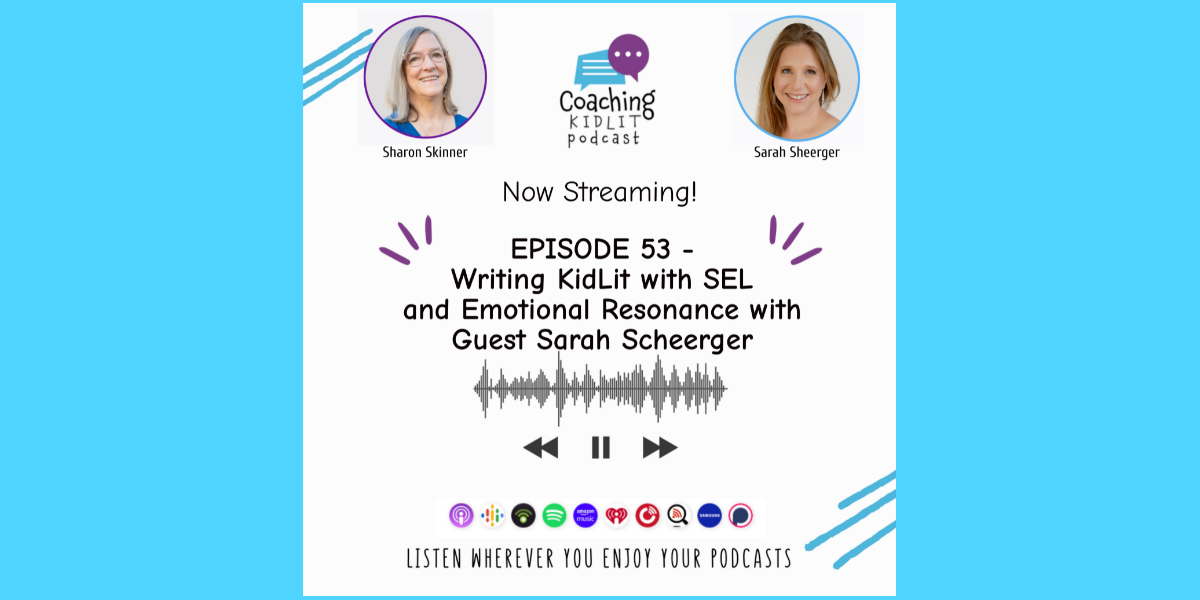
Coaching KidLit Episode 53: Writing KidLit with SEL and Emotional Resonance with Guest Sarah Scheerger
In this episode, Sharon Skinner interviews author and mental health clinician Sarah Scheerger about integrating social-emotional learning (SEL) into kidlit. Sarah Scheerger discusses her writing journey, the inspiration behind “Dude, Be Nice,” and the importance of empathy and perspective in children’s books, revision insights, educator resources, and actionable writing tips.
Connect with Sarah Online:
Website: https://www.sarahlynnbooks.com/
Instagram: https://www.instagram.com/sarahscheerger/
X: https://twitter.com/
Facebook: https://www.facebook.
Topics Covered
- Overlap between children’s literature and social-emotional learning (SEL) [00:02:03]
- Incorporating SEL concepts into books for different age groups [00:02:13]
- Real-life inspirations (e.g., Dude Be Nice and Mitzvah Pizza) [00:09:01]
- Evolution and revision of a picture book manuscript [00:15:46]
- Using mentor texts for tone and voice [00:15:26]
- Differentiating tone and voice (deadpan, voicey, rhyming) [00:21:17]
- SEL resources for authors and educators (e.g., casel.org) [00:28:12]
Books Mentioned
Tip Tap Pop by Sarah Scheerger
1, 2, 3, Va-Va-Vroom! by Sarah Scheerger, Illustrated by Daniel Griffo
The Boulder Brothers: Meet Mo and Jo by Sarah Scheerger, Illustrated by Pierre Collet-Derby
The Opposite of Love by Sarah Scheerger
Operation Frog Effect by Sarah Scheerger
Mitzvah Pizza by Sarah Scheerger, Illustrated by Deborah Melmon
Dude, Be Nice by Sarah Scheerger
Purple Up! by Sarah Scheerger, Illustrated by Leah Giles
Books by Ellen Hopkins
Dragons Love Tacos by Adam Rubin — illustrated by Daniel Salmieri
Pete the Cat series by James Dean, Eric Litwin, and Kimberly Dean — illustrated by James Dean
Other Resources/Mentions:
- Dude. Be Nice — the real-life inspiration behind the book Dude, Be Nice
- Rosa’s Fresh Pizza (founded by Mason Wartman) — the Philadelphia shop that inspired Mitzvah Pizza
- CASEL (Collaborative for Academic, Social, and Emotional Learning) — a leading resource for social-emotional learning concepts
- sarahlynnbooks.com – Sarah Scheerger’s author website, which includes curriculum guides and more information about her books
Listen:
Transcript:
[00:00:00] Sharon Skinner: Welcome to coachingkidlit.com, a podcast about writing and publishing. Good KidLit. We dig into various aspects of writing craft through a KidLit lens and provide inspiration and clear actionable items to help writers like you move forward on their KidLit writing journeys. I’m Sharon Skinner, author accelerator, certified book coach and author of Speculative Fiction and KidLit, including picture books, middle grade and young adult.
[00:00:29] Hello listeners. It’s Sharon again, and we have another special guest for you this month.
[00:00:34] Sarah Scheerger is an author and mental health clinician.
[00:00:38] She provides school-based counseling services for at Promise Youth and helps them figure out who they are and who they want to be. The Dude, be nice! organization caught her attention and served as inspiration for Dude. Be Nice. This is her 10th book. For more information and fun activities related to her books, you can check out her website at.
[00:00:59] SarahLynnbooks.com and that’s S-A-R-A-H-L-Y-N-N-B-O-O-K s.com. Sarah, welcome to the show. I’m excited to talk to you today.
[00:01:10] Sarah Scheerger: Thank you for having me. I’m excited to be here.
[00:01:12] Sharon Skinner: Sarah, you’ve got an interesting journey. You’re a health clinician and you write children’s books, and you’ve been able to combine those things together. Talk to us a little bit about your journey and how you ended up where you are at today with your writing and your work.
[00:01:30] Sarah Scheerger: Sure. You know, I think over time I’ve figured out that there’s actually a lot of overlap between the different hats that I wear in my life. one of my hats is out of a mom. I’m a mom of four, and so that colors everything that I do. Another hat that I wear is I’m a school-based mental health provider, so I’m a school counselor who provides traditional counseling services with students who are needing a little extra support.
[00:01:53] And in that role I’ve also done some social emotional learning activities. With large groups and classroom discussions, and so that colors my work as well. And then I love children’s books and I realized that there’s an organic overlap between writing for children and what we call social emotional learning.
[00:02:13] Because when you read a really good book, you connect so deeply with the character. You feel empathy for them and their experiences is almost as if you become the character when you’re reading a good book. And so you get to see the world through their eyes. So that gives you perspective, it gives you empathy, it gives a reader a chance to try on.
[00:02:33] Different choices in life. Even when a, character is making what we would call an unhealthy choice, you’re still learning through that experience. You learn what not to do and what to do. There’s just opportunities to teach all kinds of social emotional learning concepts. So it took me a while to realize that there was an overlap, but once I did, I try to bring it into my work whenever I can.
[00:02:52] Sharon Skinner: So tell us about the first book that you wrote then, in this overlap scenario.
[00:02:57] Sarah Scheerger: Okay, so my first couple of books, I’ll just kind of go through them in order. I wrote a couple picture books, tip Tap Pop, which is about a grandpa who is aging and learns to communicate, through dancing. I wrote accounting book 1, 2, 3, Va-Va-Vroom!. I wrote an Easy Reader. The Boulder brothers, meet Mo and Joe.
[00:03:14] And then I think I began some of my YA work and I would say my young adult novels all have to do with deeper issues, more complex issues. one of the books covers Teen Pregnancy, and that’s opposite of love. Another book dives into. A school in the aftermath of some fear of school violence and the kids band together to create a crisis hotline to try to improve their school culture and reach out to people.
[00:03:42] And, my third ya, How to Live On the Edge. Is really about coming to grips with our bodies as women and it has to do with breast cancer. So those all have kind of some deeper issue counseling overlay to them. But I think it really. Crystallized for me when I wrote Operation Frog Effect, which is a middle grade novel written in eight points of view.
[00:04:03] And because there’s eight points of view, as the author, I really had to get into all the characters heads, and I had such great fun, honestly, creating misunderstandings and Having them to have to solve their problems between each other. And I think that that is honestly so representative of a lot of the challenges that kids have in schools day to day is that everybody’s kind of walking around seeing their world through their own eyes and their own perspective and forgetting to think about how things might impact other people.
[00:04:32] And I have been able to use that idea of perspective for humor too in my, easy reader. The Boulder Brothers Meet Mo and Joe. The humor comes from the fact that the two characters. Know a lot less than the young child reader knows. And so reading the book, the young child is gonna know what’s happening more than the characters do.
[00:04:48] So in one scene, something smells really bad and you can see throughout the illustration that there’s a skunk in the background. But poor little Mo and Joe who are cavemen are running around trying to put flowers in their armpits and take baths and clean their cave, and the reader themselves knows more than the character.
[00:05:04] So I’ve just had fun playing with perspective. and that translates also to Mitzvah Pizza and Dude, Be Nice, which have strong kindness themes and purple up as well as a book celebrating the contributions of military kids. And so I want people to, understand and see how much these young people are donating to our community as well.
[00:05:24] So that was a long answer, but hopefully I touched on it a little bit.
[00:05:26] Sharon Skinner: absolutely. So what motivated you to, move into children’s writing then? What was the spark, the moment that you decided I just have to start writing these books?
[00:05:36] Sarah Scheerger: That is a great question. I think originally when I was a kid, I really loved writing and being creative and it was a passion of mine. But then somehow as I was growing up, I. had to get practical. I didn’t focus on it. It just kind of fell to the side. and when I was a young mother, I had just had my first child.
[00:05:53] I found myself with little pockets of time when my son was napping and in theory, I should have been doing laundry or dishes or cleaning the house or exercising. A million things I could have been doing that would’ve been very productive. But I honestly wanted to spend the time. More internally and I found myself drawing to journaling and then writing.
[00:06:12] so I think I started with the journaling and then I was reading books to him and loving them and finding them brilliant and thinking, man, I used to love writing and stories and maybe I would like to spend some time on that again. So that’s when I sort of more seriously began to set aside writing time in my life.
[00:06:30] And it took a while, but finally things started to pan out.
[00:06:34] Sharon Skinner: Do you have an agent who reps all of these age categories?
[00:06:38] Sarah Scheerger: I do. Yeah. I’m represented by Deborah Warren at East West Literary.
[00:06:42] Sharon Skinner: That’s unusual because a lot of times we have agents who, you know, rep a specific age category, like all picture books or even a specific niche of picture books, or they do ya and it’s really, awesome to hear that there are agents out there who will rep across categories, but I wanna ask you, did she rep across categories or did you kind of help her push that envelope?
[00:07:05] Sarah Scheerger: She’s amazing. I think she’s a wonderful networker and she has relationships with people from all different houses, so I give her all the credit. she’s connected in all the different spheres and really open to letting her, talent direct. Where their, career goes. What they wanna focus on, what they wanna write.
[00:07:25] Sharon Skinner: Oh, that’s awesome. Because not all agents are built that way, so that’s exciting to hear. I know that there are people out there hoping that they’ll find that agent who will allow the growth and the expansion across time.
[00:07:38] So you. We’re already writing these social emotional learning types of books.
[00:07:44] this is what you’re drawn to. Operation Frog Effect, which is about the rippling out of doing good things and doing good work in the world. Looks like a really fun book. I haven’t read that one yet, so that one is totally on my list. It’s very important for teens to read about the what ifs, what if this happens to me, what could happen to me?
[00:08:03] It helps them not do a lot of those things. A lot of times my youngest was a big Ellen Hopkins fan and I firmly believe that some of why she was so successful in navigating her teen years is because she was able to see the pitfalls that are explored in books like that.
[00:08:20] And that’s what it sounds like your YA Books are doing as well. There’s such an important place in the world for those kinds of books.
[00:08:27] Sarah Scheerger: Thank you. I agree.
[00:08:28] Sharon Skinner: So, You were already writing all these SEL books. You were already contributing to that, Arena of literature for young readers, and it is such an important area, especially when we get down into the younger ages because those are our really formative years and you’d written a number of picture books and now we get to dude, be nice.
[00:08:51] Dude, be nice. Isn’t just a picture book though. It’s a book that you decided to write because of this organization. Can you tell us a little bit about the organization and, how this all came to fruition?
[00:09:01] Sarah Scheerger: Absolutely. So, in. Part of my work as a school-based counselor, I do presentations to youth and talking about different social emotional learning topics. So actually two of my books were inspired by people out there who were doing amazing things in the world and needed to be highlighted. My book Mitzvah Pizza was inspired by a real life pizza shop in Philadelphia called Rose’s Fresh Pizza, which is basically pay it forward pizza.
[00:09:26] over time. People came in and people would wanna buy a piece of pizza for somebody else. I think they were in the area where there might have been more poverty. And so if someone wanted to come in and buy a piece of pizza for somebody else, he would just take their money and then write on a post-it note, that that pizza had been paid for, take it to the wall and people would come in and take that, post-it off, and that’s how they could pay for their pizza.
[00:09:47] So I came across that when I was prepping for a presentation. For school kids. And that turned into a picture book called Mitzvah Pizza. and then the same thing happened with Dude, be Nice. I was prepping for a presentation. I was looking for something about kindness and altruism, and I came across a video that they created highlighting a custodian.
[00:10:07] And in elementary school, it was actually near to my home and it made me cry. It was so poignant and meaningful. This was a custodian who’d been there for many, many years, knew all the kids, they loved him, and they basically, in this video set up an enormous surprise for him to honor him for all of his work and contribution.
[00:10:25] And not only did I feel excited about that for the custodian because. The custodian was doing such great work, but I felt excited about that for the kids because they got to give back. A lot of times kids are the recipients of love and support, and it’s actually also quite healing to be able to give back to somebody else that altruism.
[00:10:44] So I, loved that the kids could plan a whole event for someone they cared about and get the experience of that being recorded. so once I saw that video from Dude, Be Nice. They were kind of on my radar. And I kept seeing them pop up in all different places. They have a project they call the Dude Be Nice Project, which just sets out to create more positive communities.
[00:11:02] Finding the unsung heroes and setting up an elaborate surprise and coming in and surprising them. In mostly schools, but in communities too. They also have a clothing line that says, dude, be nice. And I started thinking too about how universal the word dude is. One of my best friends from college used to say, dude, all the time, he’d say it as a greeting dude.
[00:11:22] He’d say it like to show empathy, dude. He’d say it to show frustration, dude. So I just realized dude was just a great word and could be used in so many different ways. So once I started thinking about that, this character of a dude popped into my head and I live in California, so it’s kind of a southern California.
[00:11:39] Skateboarder surfer vibe was what I was thinking in my head. A character named dude who was nice, and that’s all I had and it lived in my mind for. Probably a couple of years. And then at some point I reached out to the company and said, have you ever thought about writing a picture book? And they said, yeah, it’s actually been on our to-do list, but we didn’t know how to start because that’s not their field.
[00:12:02] And so we partnered up and, it was a long journey from that point forward because dude took on many different forms before we landed on the right one. But I’m just so honored to be able to support a company who’s doing good things. I want more people to know about the company Dude, Be Nice. I want more people to watch those videos.
[00:12:20] I know for myself, when I watch the news, I am overwhelmed with the heaviness of things that are happening in the world. And I don’t wanna just consume that content. I wanna consume content that’s positive. And I, in my day-to-day life, I see those people. I see the custodians, I see the lunch lady, or the lunch man.
[00:12:35] I see the people who are pouring their hearts into our kids, and I want everyone else to see those people too.
[00:12:40] Sharon Skinner: Well, I’ve seen some of them now too, because I, of course went to the website. I watched the video. I, practically cried.
[00:12:48] Sarah Scheerger: They all make cry.
[00:12:49] Sharon Skinner: It’s joyful to see that kind of love and joy it’s an amazing feeling when kids pour it in. And so I just love seeing those people who have, like you said, continue to support and care for and pour goodness into the kids that they work with and that they work for, and to see them get.
[00:13:10] Recognition of that nature. that’s huge. And I know they don’t do it for that. That’s not why they do it. But like you said, the kids get this opportunity to show how much they appreciate someone. Boy, that is just a really great idea and it puts really good things in the world. I want to see more good things in the world. Of course we do. That’s why we do children’s books. That’s why we’re interested in kids’ literature. We wanna put good things into the world. I’m gonna give kids those experiences. So I think it’s a great organization. I am excited about it.
[00:13:44] But when you took the idea to them. And you had this kinda surfer dude idea. I’ve seen the preview and that’s not a surfer dude.
[00:13:53] Sarah Scheerger: Yeah. So there was a lot of evolution with the idea. I think. it popped into my head with a few components I wanted to keep. I wanted it to be called Dude, be Nice. I wanted the character’s name to be, dude. I wanted there to be a theme of kindness throughout. The rest I wasn’t so sure about.
[00:14:11] And so I played with different approaches and as I’m sure you know as well as a author, we don’t necessarily get to pick how the characters look, right? So I love the illustrator, Alex. She’s done an amazing job that was all her own creativity. So. what I envisioned is different than what she envisioned.
[00:14:28] And thank goodness for that because it turned out way better. and I feel that across the board with all
[00:14:32] of my books, it’s never exactly what I imagined, but it’s always better because you’re combining two people’s creative minds. And yes, dude took on many forms, during the writing journey.
[00:14:42] So this story really began before the pandemic. And then it kind of settled down and went quiet for a little while because the world was upside down. and so it actually took quite a long time from the moment that we began working on this together as a collaborative team to now having the book come out.
[00:14:59] And I remember thinking like, oh, maybe it’s good that it’s taking longer because the world is upside down and we need more time, and maybe the world will settle. I feel like the world is still upside down in a different way. But, it’s coming out now and I’m hoping it’s the right time for some positive dude, be nice energy.
[00:15:13] but it did take on some different forms along the journey. At first, I really was visualizing this story. I had Pete the Cat in my head is what I can say. I kept thinking Pete the Cat is such a great character and we need another book like that. but honestly, Pete the Cat is so genius and so simple.
[00:15:29] It was really hard for me To try to dissect what was making it work. So I spent a long time reviewing books like that. We call them mentor texts, as I’m sure you know. But reviewing them and trying to figure out what makes that work, it’s so great. It’s so simple. So I spent time working and looking at books like that, and my very first version was rhyming.
[00:15:48] It had a surprise at every page turn. It was very young. And, it was building to a big surprise. The character dude was planning a prize for somebody at school and each step was getting closer along the way. And it was sweet and simple, but it wasn’t quite right. So I went back to the drawing board and I was trying to find something a little more voicey.
[00:16:06] And so again, I leaned into mentor tests I was looking for, books that were voicey distinct, unique. And I read, Dragons Love Tacos, which is an amazing book, and tried to again, dissect what makes that work. why is that so amazing? It is amazing. Why is it amazing? and I played around with the version that was kind of voice like that, and having the reader talk to Dude directly.
[00:16:28] So the text would be like, dude, look up or something. And then so you’d be talking to dude. So I played with that. It was funny and silly. It was building to a big surprise again. but maybe, too silly. Maybe too wordy. I’m not sure. It didn’t quite work either. So I went back to the drawing board again and this time I was going for a deadpan humor,
[00:16:45] simple and you know, minimal reaction from dude.
[00:16:49] And that’s the one that stuck.
[00:16:51] Sharon Skinner: So how many iterations do you think you went through? And these are complete. Overhauls. This is not just a revision or a rewrite or an edit. this is a major overhaul. So how many versions do you think you did?
[00:17:04] Sarah Scheerger: I had three main, totally different submittable versions, ones where I thought it was done. and each version I probably revised, I wanna say like 30, 40 times. So many times I, I revised it over and over and over again, trying to get it just right to the point where I felt it was done. And then I think it wasn’t really done, so I needed to go back and kind of revisit it again.
[00:17:24] And, you know, the revision can be a frustrating process. and yet. It also can lead to the best results. And so I kept telling myself like, it’s okay if it takes me a while. It’s okay if I don’t get it right. I just want it to be right when it’s done. And I do feel that this
[00:17:38] version that came out was the best version. So I’m grateful for all the ups and downs.
[00:17:42] Sharon Skinner: And those overhauls that you were doing, were those, on your own, did you decide, okay, this isn’t quite right, or were you working with your agent on that? Did you have beta readers? What kind of process were you going through for that?
[00:17:55] Sarah Scheerger: Yeah, that’s a good question too. So I basically sold the book. I had an interested editor fairly early on. So once she was interested and the contract may not have been signed yet, I can’t remember exactly when, when she was interested. I submitted what I thought was the final version and I think she fell in love with the idea of, dude, be nice.
[00:18:14] But the, way it played out wasn’t exactly what she envisioned. So she came back and said, let’s see if we can have something more voicey. So I went through and my original draft could not have been voicey. It wouldn’t have worked. it wasn’t a voice draft, it was a sweet rhyming, very young draft.
[00:18:28] So I came back with a draft that was more voicey. And got that to the best that I could and submitted it. And I think she, liked it, but came back and said, you know, I think what I was envisioning was a little more deadpan humor. And so that Voicey tone wouldn’t have worked with deadpan humor. It needed to be more simple.
[00:18:46] So. Revision is hard. In this case, I felt so lucky to already have an editor on board because in my experience, often when you submit, if it’s not what they’re looking for, they say, yeah, you know, I was really wanting something more boic, but that’s it. The door’s closed. You don’t get to revise it. So I would much, much rather have a situation where I have an editor who is invested and says, I would like it this way.
[00:19:09] I’m happy to revise. I will revise it a hundred times as long as I feel like there’s a path forward and it’s gonna end in something.
[00:19:15] Sharon Skinner: So, revise and resubmit situation is of course, always the best scenario, right? You definitely want to be able to do that. We don’t always get that opportunity, especially in our early careers, early career is exactly what you say. You send it off and they either like it or they don’t, and they usually don’t wanna see it again.
[00:19:36] If they didn’t like exactly that version, they might be interested in. Something else you’ve written, but definitely they don’t wanna see that again. And not unless it has, like you said, a major overhaul. And even then, a lot of times they just, they’re not
[00:19:51] interested. Right. They didn’t see enough in it.
[00:19:54] Sarah Scheerger: exactly, and I think the market is so saturated. There’s so much amazing literature out there that it just kind of has to land Most of the time it has to land on their desk pretty much close to, right?
[00:20:04] Sharon Skinner: And you have to hit the right person with the right thing at the right time. And it’s gotta be right. It does make what we do, quite challenging.
[00:20:11] Sarah Scheerger: Yes, and I think so it’s just amazing that it ever works out, right, because it’s just so many pieces that have to kind of, the stars have to align for it to become a book. And I think that’s what aspiring writers should know, is that it’s such a journey. Truly. It’s such a journey and I see it as, a wonderful, enriching hobby and coping skill, and a way to put my energy.
[00:20:31] The stars have to align. Just because something doesn’t sell doesn’t mean it’s not good or it doesn’t have value in the world, or it wasn’t worth the time. It just means the stars
[00:20:38] didn’t align on that project. It’s hard to admit, and to accept, but I think that’s the way I try to view it so I don’t get discouraged.
[00:20:45] Sharon Skinner: Yes. And perseverance pays. You know, if, if you keep going and keep going, you’ll hit, you will. The stars will align on something.
[00:20:54] Sarah Scheerger: Eventually, yes, I agree.
[00:20:56] Sharon Skinner: So in the three major overhauls that you did, all three of them were very different in tone and voice and somewhat even in target audience. I’d like you to kind of dig in on the differences between, especially what you were saying between the deadpan humor and the very voicey. What do you mean by that?
[00:21:16] Sarah Scheerger: Well, let me show you by example. What I’d like to do is kind of give a brief intro to each of the three main finished. Versions that I have and read the first page of each. So in my very first version, I was thinking Pete the Cat and I was trying to have the story plot aligned with the actual surprises that the Dude, Be Nice company has done with the main character planning a surprise for a school.
[00:21:39] And I wanted this version to be for very young readers. The story rhymed and each page turned revealed something new. So. Dude is walking to school and trying to do something nice on the way. So here’s the intro. The first page, dude can’t wait to get to school. He’s planning a surprise, dodging legs and spinning wheels, when suddenly he spies.
[00:22:00] And then the page would turn and you see what he spies on the next page so that you can hear that the tone of that is a little sing-songy. Very sweet and simple. In my second finished version. That was a little bit more voicey and I was reading Dragons love tacos and, voicey books like that to try to embrace the mentor text.
[00:22:20] In this version, my narrator, the reader talked directly to dude and I was trying to be snappy and voicey. And again, in this version, dude was planning to surprise someone special, but getting it all wrong. This one has a voicey tone. Dude, what’s up Besides the sky? Of course, he, he, he, that always cracks me up.
[00:22:38] Ooh, what you got there, dude? Is that a cake? You’re famous doubledecker cookie cake. So you can tell that tone is more pumped. more wordy, not simple. would need to be read with the right reader. I think that might’ve been one of the things that made it hard to pull off. In my final version, I was trying to channel more deadpan humor.
[00:22:56] And in this version, I wasn’t having to plan a big surprise at the end. I was just having him try to be nice and basically getting it all wrong. So in this version, dude is very ecocentric. He’s seeing the world only through his own eyes. He’s not realizing that what he’s doing to help others is actually not helpful at all.
[00:23:13] so it’s very silly. So the opening of this one is Meet dude dude’s. A nice dude. Most of the time he says, please and thank you. He picks up trash and he’s always cheerful. And of course we know he’s not gonna be always cheerful and he’s not gonna be nice all the time. So that’s kind of a taste of the different tones and openings to the book.
[00:23:35] And I like the one we wound up with best. Honestly, the one I was in the midst of the other ones. I love those ones too. But reading them now, I think the one we wound up with is better.
[00:23:44] Sharon Skinner: I really appreciate you sharing those three versions. We don’t get to see that a lot and especially nowadays, we used to be able to go and see the original marked up manuscripts, the typed up with all of the editorial notes on them from people that kind of ephemera. We don’t have as much of anymore because we work so digitally.
[00:24:04] So I really appreciate you sharing those three different versions and giving us the flavor of it rather than just talking about it. So thank you for that.
[00:24:12] Sarah Scheerger: Thank you.
[00:24:13] Sharon Skinner: So we are about at the point in our show where we like to give our listeners an action item.
[00:24:18] And Sarah, you have an action item for us today.
[00:24:22] Sarah Scheerger: Yes. I would like to encourage people to do what I did with Dude, where you have a story in mind, or a character or a plot and trying to rewrite it just for fun. No pressure. Rewrite it with different tones and voices and from different angles and just see which one winds up being the best. I find that writing without pressure allows the creativity to flow a little bit better.
[00:24:47] And so if you’ve got an idea that you wanna pursue, just spend a little bit of time playing with different ways It could be written different ways, it could play out, and
[00:24:56] then sit with it for a while and see which one calls to you the most.
[00:25:00] Sharon Skinner: That’s a great action item. We talk a lot, here on the show about trying things different ways, but we haven’t really talked as much about tone and voice in that, and I love that you have given us a really great example. Before giving us the action item to go out and try that.
[00:25:18] My action item for our listeners is to think about social emotional learning and how you can incorporate that into your own work.
[00:25:28] What do you understand about the world and about empathy and about behaviors that maybe you have personal experience with? Because we were kids, we went through a lot of things, or maybe you have kids and you see some of those behaviors that. Maybe you can incorporate into a story with a character to help others either have empathy for that character or to show how that character can grow.
[00:25:53] So I highly recommend that you think about and take a look at what Sarah’s done with her books. She’s got a very nice array of books that contain social emotional learning and information. That I think would be very valuable for you to take a look at her books. So when we’re talking about mentor texts, check out Sarah’s books along with the other books that you might be using as your own mentor texts.
[00:26:18] Sarah Scheerger: Appreciate that. And I wanted to add that, you know, teachers in the classroom have a lot of topics to cover. They are covering all the core curriculum and they have to do what we call social emotional learning. So if they can pick up a picture book and read it. To their students and they can incorporate some learning with that. It maximizes their time.
[00:26:35] Sharon Skinner: And Sarah, in your books, is there back matter that supports the teachers in teaching those lessons?
[00:26:41] Sarah Scheerger: Yes. for my more recent books, I have curriculum guides on my website that can just be downloaded and They align with what I see are the SEL concepts in the books that I’ve written. And so each of them comes with like an activity or a discussion. I wanna make it as easy for teachers as I can to read the book and then grab an activity that calls to them or they think speaks to their students and.
[00:27:03] Do that with their kids and just save them a little bit of time. And in a book like, dude, there’s obviously, there’s kindness and empathy, there’s perspective taking, understanding feelings. There’s the idea of listening. What does it mean to listen? What does it mean to be responsible coping when things get hard, asking for permission, which we call consent, growth mindset.
[00:27:21] You don’t get it right the first time. Mistakes are how we grow. Sharing all those are just in one little picture book. So there’s a lot there.
[00:27:27] Sharon Skinner: now Sarah, you’re the clinician. So, you know, all this stuff, you live it, you, breathe it. This is something you, work with all the time. For those of us who are not clinicians, is there a resource that we could look to for how we identify the social emotional learning that maybe we put into our books?
[00:27:44] not even necessarily intentionally, but things that our characters are going through that we can maybe identify those, SEL aspects that we can. Then find a way to create a curriculum An educator’s guide and or the back matter that would go into a book. Are there any resources that you might want to recommend?
[00:28:02] Sarah Scheerger: Yeah. you know, I, I am just looking up the website right now. I like CASEL, CASEL stands for Collaborative for Academic Social and Emotional Learning, and the website is CASEL.org. So it’s a great resource.
[00:28:17] Sharon Skinner: Thank you for that. Appreciate that. See, I knew you would know.
[00:28:20] This has been great and I’ve really enjoyed it. And, I would also say to our listeners that if you are looking for someone who knows how to do an educator’s guide or some sort of curriculum guide for a book.
[00:28:33] Sarah has one for pretty much every book that she has put out, and I think it’s really valuable to look at those resources and to see how someone who knows what they’re doing has done it. I also found it really exciting that you are being published by many different publishing houses, so there is an opportunity for these kinds of books out there and not just at maybe a niche publisher.
[00:29:00] So I thought that that was really an interesting aspect as well. Sarah, is there anything else that you’d like to share with our listeners before we sign off today?
[00:29:09] Sarah Scheerger: Yes, I would love to share an audio of some music that the Dude, Be Nice Company has created. We have a do Be Nice jingle ’cause we’re hoping that the idea of being nice and being nice dudes will catch on with students and classrooms and schools all over the country and the world.
[00:29:25] So I’m gonna play this audio for you. It’s very short
[00:29:29] Dude Dance Audio: do the dude dance. Clap twice. Do the dude dance. Be nice. Do the dude dance. Clap twice. Do the dude dance. Be nice. He’s out to be nice and nice. He’ll be 1, 2, 3. Just wait and see. Shake it out from head to toes. Drill around now stop and pose. Do the dude dance. Clap twice. Do the dude dance. Be nice. Do the dude dance. clap twice do the Dude dance be nice.
[00:29:52] Sarah Scheerger: Thank you for your time today. It’s been lovely talking to you, and I’m so grateful for the chance to share Dude Be Nice and my other work with the world. We need more dudes out there being nice, and we need more people highlighting the unsung heroes in this world. So in closing, dude, be nice.
[00:30:07] Sharon Skinner: Thank you Sarah, so much for being here. It has been a pleasure.
[00:30:11] Sarah Scheerger: Likewise. Thank you so much for having me.
[00:30:13] Sharon Skinner: Bye for now.
[00:30:14] Sarah Scheerger: Bye.
[00:30:14] Sharon Skinner: We hope you’ve enjoyed this episode of Coaching KidLit, a writing and book coaching podcast for writers who want to level up their KidLit game. For more episodes, visit coaching KidLit dot com and to find out more about what a book coach could do for you, visit my website, book coachingbysharon.com.
***
Follow us on Instagram and Twitter: @CoachingKidLit
For more information about Sharon Skinner, visit bookcoachingbysharon.com or follow her on Instagram @sharon_skinner_author_bookcoach
***
Want to know more about working with a Book Coach on your KidLit book? Check out my KidLit Coaching Page or fill out my inquiry form to schedule a FREE Consult call and let’s get started!
Keywords: Kid lit, Social Emotional Learning (SEL), children’s books, writing craft, empathy, perspective, character development, picture books, middle grade, young adult (YA), mental health, school counselor, kindness, mentor texts, revision, voice, tone, deadpan humor, curriculum guides, educator’s guide, publishing, agent representation, altruism, classroom activities, unsung heroes, Dude Be Nice, Mitzvah Pizza, Operation Frog Effect, Pay It Forward, growth mindset, collaboration, perseverance, book journey, teaching resources