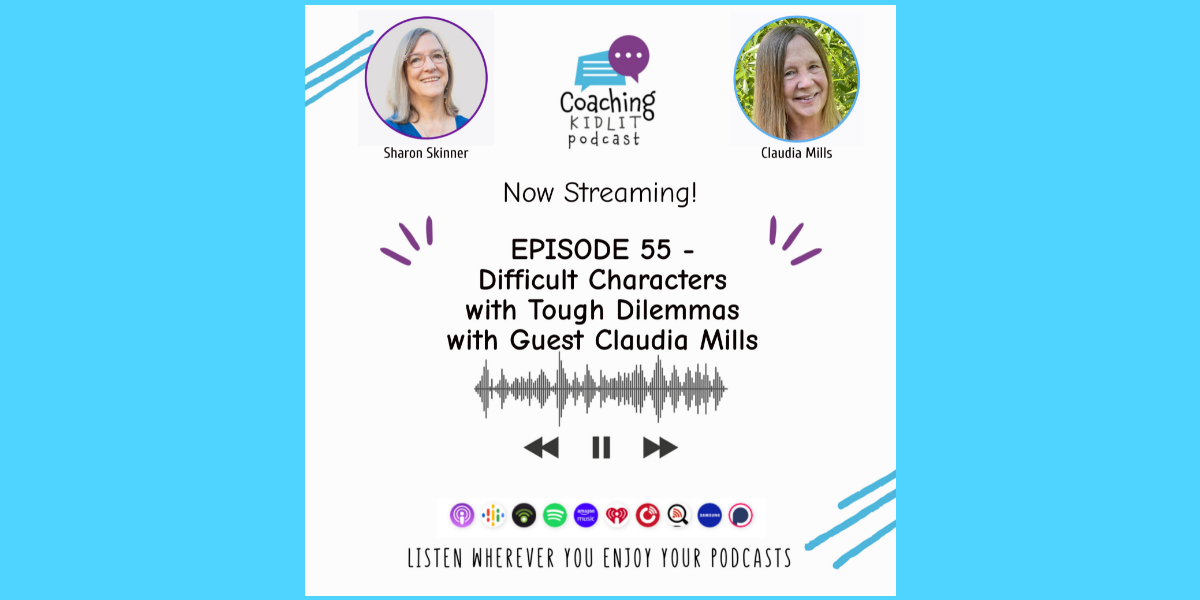
Coaching KidLit Episode 55: Difficult Characters with Tough Dilemmas with Guest Claudia Mills
In this episode, Sharon sits down with acclaimed children’s author Claudia Mills, who has penned over 60 books for young readers across all age categories. Together, they dive deep into the art of crafting difficult characters with tough dilemmas, drawing from Claudia Mills’s latest middle grade novel, Calliope Callisto Clark and the Search for Wisdom. Discover how Claudia Mills’s background in philosophy enriches her stories, why asking big questions matters in middle grade fiction, and actionable tips for making characters leap off the page.
Connect with Claudia Online:
Website: https://www.claudiamillsauthor.com/
Instagram: https://www.instagram.com/claudiamillsauthor/
Bluesky: https://bsky.app/profile/claudiamills123.bsky.social
Facebook: https://www.facebook.com/claudiamillsauthor
Topics Covered
00:00 Introducing Claudia Mills
13:33 Understanding complex characters
18:54 Discussing fairness and philosophy
22:57 Engaging with Philosophical Thinking
26:51 Developing Character Voice and Depth
37:08 Characters facing personal struggles
Books Mentioned
- The Last Apple Tree by Claudia Mills
- The Lost Language by Claudia Mills
- After School Superstars chapter book series by Claudia Mills
- Calliope Callisto Clark and the Search for Wisdom by Claudia Mills
- Write This Down by Claudia Mills
- 7 x 9 = Trouble! by Claudia Mills
- The Rainbow Fish by Marcus Pfister
- Shiloh by Phyllis Reynolds Naylor
Other Resources/Mentions:
Philosophy for Children
Gareth B. Matthews, The Child’s Philosopher
Nietzsche
Kant
Aristotle
Epictetus
Plato
John Stuart Mill
Listen:
Transcript:
Sharon Skinner: [00:00:00] Welcome to Coaching KidLit, a podcast about writing and publishing good kid lit. We dig into various aspects of writing craft through a kid lit lens and provide inspiration and clear, actionable items to help writers like you move forward on their kid lit writing journeys. I’m Sharon Skinner, author accelerator, certified book coach, and author of speculative fiction and kid lit, including picture books, middle grade, and young adult.
Hello, listeners. Welcome to Coaching KidLit. Today’s guest is Claudia Mills. Claudia is the author of 60 books for young readers, including picture books, easy readers, chapter books, and middle-grade novels. Her most recent titles are The Last Apple Tree, The Lost Language, and the After School Superstars chapter book series.
She was also a professor of philosophy at the University of Colorado at Boulder for almost a quarter of a century, specializing in [00:01:00] ethics and political philosophy, and currently teaches in the graduate programs in children’s literature at Hollins University in Roanoke. Her books have been named Notable Books of the Year by the American Library Association and translated into French, Spanish, Italian, Hebrew, Japanese, Korean, and Chinese.
All of her books were written between 5:00 and 7:00 in the morning, lying on the couch with her favorite clipboard, narrow ruled pad of white paper, and fine-tipped black marker pens while drinking Swiss Miss hot chocolate. It can’t get any more fun than that.
Welcome Claudia. I’m excited to have you on the show
Caludia Mills: I’m so delighted to be here. Thank you so much for having me
Sharon Skinner: So Claudia, you also just released a new book
Caludia Mills: Yes, I did. Its title’s a bit of a mouthful. It’s Calliope Callisto Clark and the Search for Wisdom.
The girl in the book, whose given name is Callie Clark, decides that it’s not a grand enough name for her as she starts middle school, and she loves everything [00:02:00] that has to do with Ancient Greece. So she looks up names that Callie could possibly be short for, and ends up with Calliope Callisto Clark and the Search for wisdom
Sharon Skinner: I love it. And, I really like that there’s a little bit of the appeal to readers of Fancy Nancy in the idea that your character wants to be fancier than who she is, and I think that that is going to resonate with a lot of your readers
Caludia Mills: I hope so Because A lot of my recent books have been about characters who are more introspective, introverted, quiet, where they need to find their voice. Callie does not need to find her voice. Callie has her voice, and it rings out loud and clear right from the start of the book. And so I hope that readers will identify with that too, who are forces to be reckoned with, as Callie is herself
Sharon Skinner: You’ve published over 60 books and across the age categories in children’s literature from picture book on [00:03:00] up, but you’re focusing more on the chapter books and middle grade books at this point in your career.
Caludia Mills: That’s right
Sharon Skinner: Give us a little bit of your journey into writing and how you got to where you are now
Caludia Mills: I’ll try to make it as concise as possible. I wrote my first book, so-called, when I was six years old, and all it had in it was pictures of the rainbow, and I wrote rainbow. Pictures of the sky, I wrote sky. Pictures of a tree, I wrote tree. But at the end, I had advertisements for the future books I was going to write, and I promised that there would be a big book, 100 pages of my life, and a thick book, 100 pages of poetry, spelled P-O-W-A-T-R-E-E, powatree.
So I had these big dreams very young, and I actually wrote the big book, 100 pages about my life, when I was in eighth grade. I wrote an autobiographical count of my year, all about me, and it was the [00:04:00] sensation of the junior high. There was a waiting list for kids to have a turn to read the book. It helped that they were all in the book, so they wanted to see what I said about them.
But it also taught me that you could write about your own life in an honest way. I told embarrassing, humiliating things that had happened to me, but I made them funny and I made them real. And so that was really my breakthrough as a writer. But then I went off to college and I studied philosophy. I fell in love with philosophy, the big ideas, the thrilling ideas of the great writers from antiquity to the present who were exploring questions about existence and morality and the meaning of life.
And I went on to graduate school in philosophy, and I thought I had left my writer self behind. But partway through graduate school, I happened to see an advertisement in The New York Times. And I was a grad student in Princeton, which is in New Jersey, so I [00:05:00] was near New York. I saw an advertisement in The New York Times for a position In children’s book publishing, and it said, “Call today.”
And so I interviewed for this job. It was a job at Scholastic. I dropped out of graduate school, and I became a secretary to three editors at Four Winds Press, which was at the time the hardcover trade division of Scholastic. So I was all of a sudden commuting from Princeton to New York every single day on the bus, working in children’s book publishing, and I got very serious then about writing.
I sat on the bus and wrote and wrote. I wrote picture books because I thought they were easier.
They’re harder, I didn’t know this. I sent them off to various publishers. They all came back rejected with just a form letter. Of course, nowadays, you don’t even get a form letter. It’s just a, “You don’t hear from us in three months, we’re not interested.”
But back then you got form letters, but none of them gave me any clue about what anyone really thought about my work. And this was all before the days [00:06:00] of people having critique groups and going to writing conferences. I was pretty much on my own. And I wished I could just be in a publishing company, like a little fly on the wall, and find out what people were actually saying about my books.
And so I had a brilliant idea. I took one of my little picture books, I mailed it off to Scholastic using a pseudonym so they wouldn’t know it was me, and I could sit there and have this ringside seat to see what the fate of my book was going to be. They rejected it, and I had to type the rejection letter to myself.
Sharon Skinner: Oh, ouch
Caludia Mills: I sent them a second book, and I had to type a second rejection letter to myself. But the third time, the editor I worked for came out of her office, handed me my book, and wanted me to read it and tell her what I thought. She wanted my opinion of a book I had written, but she wanted me to type it on my IBM Selectric typewriter to write a little reader’s report, which I did.
And for the [00:07:00] first time- My book, I could see, had some flaws in it. It was not the shimmering, glittering, glorious masterpiece I had assumed it was. I saw that it was too old to be a picture book. The characters were too old. The problems were too serious. The story was too long. It shouldn’t be a picture book.
It should be a middle-grade novel. So I wrote this very compelling report about the story, praising it of course, but also critiquing it pretty severely. The editor wrote a letter to the author, who was me, but she didn’t know it, which her secretary, who was me, typed myself, and the letter said, “Dear fake name author, I’m sending you a copy of my reader’s report on your book.
And if you are willing to reply to these suggestions and revise the book accordingly, I would like to see it again.” Well, I took all the advice I had the good sense to give myself. They published the book, and I did have to tell them who I was. But that was my breakout my break-in. It wasn’t a breakout moment.
It was my break-in moment. But my career then took a [00:08:00] detour because I ended up, after being about a year and a half at this job at Scholastic, I walked into a philosophy convention that was going on in New York and bumped into an old college teacher of mine. And he was starting up a think tank at the University of Maryland called the Institute for Philosophy and Public Policy.
They wanted to hire an editor and a staff writer who had maybe gone to grad school in philosophy but hadn’t finished and had maybe worked in New York in publishing for a while. And I didn’t even want the job, but it was my destiny, so I took it and ended up moving to Maryland. I was back in the world of philosophy.
I ended up finishing my PhD, all the while publishing children’s books. And then my whole career has been intertwined between children’s book writing and philosophy, teaching and scholarship. but all by, by these accidental moments of seeing that ad in The New York Times and getting that job at Scholastic, and then bumping into the college professor at a conference, and then returning to [00:09:00] philosophy.
So Lots of twists and turns to get me here
Sharon Skinner: Lots of twists and turns, but you also took advantage of the opportunities in ways that not everyone would creatively take advantage. So the idea of submitting to your own publishing house with a pseudonym is brilliant, because how else are you gonna get that opportunity to get the kind of feedback that you were looking for?
But I also think that you realizing where the flaws were when you had to sit down and write that report for someone else is really meaningful. that way of looking at our work through another lens because we’re trying to explain it or discuss it and assess it for a third party, I think that’s brilliant
Caludia Mills: It really made a difference to take off my writer hat and put on my editor hat. And of course, we can all try doing that but it’s easier to do it if you actually have an editor hat you, that you can put on. And of course, the trick for ourselves as writers is to [00:10:00] know when to take off any editor hat and just let the story pour out, and then when to put the editor hat back on to have that critical distance.
‘Cause we don’t want to self-edit too soon. We want to allow the story to take its own and honor that part of the process. But then there comes the time when we have to take that hard, cold look at it through what might be almost a stranger’s eyes
Sharon Skinner: That’s always the balance, right? So that we don’t get stuck trying to finagle every word, every sentence, because we’re editing as we go. but we wanna get the story out of our heads and our hearts and onto the page for the reader first, and then we can make it shine
Caludia Mills: Mm-hmm.
Sharon Skinner: That’s quite the journey. so all the time that you were working in philosophy, you were still writing children’s books. So some of that philosophy was creeping into your children’s books along the way
Caludia Mills: Well, both my academic career was informed by my children’s book writing, and my children’s book writing was informed by my philosophy career. So in my philosophy classes, I sometimes would [00:11:00] use children’s books. I would read the students The Rainbow Fish, and then we would talk about why the philosopher Nietzsche would’ve hated that book.
He hated sharing and leveling and being just like the herd or the crowd. He wanted you to be on the mountaintop, breathing that rarefied mountain air. so it was so fun to read Rainbow Fish to the students. or for their final exam, I would have them read Phyllis Reynolds Naylor’s brilliant Newbery winning book, Shiloh, and have the students analyze Marty’s moral dilemma in the book using Kant and Aristotle and, John Stuart Mill.
And so that was a lot of fun. And then in my children’s books, I’d often have my characters ponder some ethical question, and I wouldn’t ever want it to be an easy one. I would want it to be a complex and challenging one, that I myself wasn’t sure about the answer for example, I have a middle grade novel, Write This Down, about a girl who wants to be a writer, and she faces a dilemma that almost every writer faces.
If you write [00:12:00] about your own life, even if it’s disguised, you are drawing on your own story, but that means some of the characters in your own story are real, living, breathing people, and what you are writing about might hurt them, might embarrass them, might have consequences for them or for your relationship with them, for them to see themselves through your eyes.
So how much are you allowed to write about your own life? Well, I don’t even know the answer to that, but I gave it to my character when she has to face that very choice in writing something about her older brother who hasn’t been very kind to her, and she wants to get even with him, but now when she’s written this thing and has a chance to publish it, she has to decide this.
So I love putting in that kind of ethical question. But only with Calliope Calisto Clark in The Search for Wisdom, did I ever have a book where my character actually reads, or sort of reads, some of the great philosophers that I love teaching.
So this is, where my two lives really come together in this [00:13:00] book
Sharon Skinner: So this is a book long time in the making
Caludia Mills: Just 40 years
Sharon Skinner: just a drop in the bucket.
Caludia Mills: nothing
Sharon Skinner: So let’s talk a little bit about Calliope now that you’ve brought us back around to her, because Calliope is a challenging character. she’s got a challenging life. She’s a difficult kid, and there are ways that you can make difficult child characters believable and not use stereotypes.
You wanna talk a little bit about the ways that we can do that?
Caludia Mills: Yeah. when I was thinking about this question, there’s this famous opening line from Anna Karenina by Tolstoy where he says, and I’m paraphrasing it a all happy families are alike, but every unhappy family is unhappy in its own way. And so I think challenging characters, difficult characters, are often unhappy or have some deep source of unhappiness, some sense of loss, some secret fear, some inner [00:14:00] demon within them.
And it’s gonna be different for every difficult character, because your difficulty of navigating your way through the world, comes from the difficult things you yourself are facing. So if you have characters placed in different challenging situations, their character will reveal itself in ways appropriate to those situations.
So I think that that helps to have the character be fresh, rather than just feel like a stock character. In the case of Calliope, who’s so emotional and who’s so intense, and feels everything more deeply than other people, I have to admit that she’s difficult in the same way that I am, and that I was.
Though I have it under control now, but I did not have it under control when I was in, elementary school. I got report card, I got an F in self-control. And throughout high school and early years of, you know, turbulent relationships with, romantic partners, I was just so intense. And so I was [00:15:00]writing something so close to my heart in having Calli have that same sort of just over the top joy and sorrow about everything that happens to her.
And I also had some self-aggrandizing notions. The way I wrote that book at age six with an ad card promising the world that they were gonna get the bounty of these wonderful future books from me. Calli has a sense of herself as being the smartest girl in the class, and that’s why she’s threatened by this boy in the class who’s new to the school, who seems every bit as smart as Calli, if not smarter.
So I identified so much with her because I did pour myself so much into her character, and I think that helped make her come alive on the page as a distinctive individual
Sharon Skinner: That’s a good point. we often include lots of autobiographical information in what we write, and sometimes we hit closer to the bone than others, I think, when we do that. And it sounds like this is that book for you
Caludia Mills: And of course, what I do is [00:16:00] even though Callie has a personality like mine, her life situation is completely different from what I had. Callie’s being raised by her grandparents because her parents, died in a car accident when she was young. Now, I was certainly raised by my own parents, but they were older parents compared to other people’s parents.
And she loves her dog. I’m not a dog person at all, so I had to project being a dog lover onto Callie ’cause I wanted to give her something high stake in the book. That’s something she cares about so much, her dog. And when there’s a threat that she may lose her dog if she doesn’t get the dog under control and herself under control.
That was an important part of the plot structure of the book. But I changed enough elements in her life from my own life that allowed me to have enough distance also from her to write her.
Sharon Skinner: Yeah, that’s always really important, to be able to have enough distance to step back and see the character as an individual, in their own right, and not as just a mirror reflection of who we are
Caludia Mills: I think that’s very well said
Sharon Skinner: So do you wanna read the blurb [00:17:00] on the back of the book for Calliope?
Caludia Mills: Of course, it has some nice things about me that the publisher wrote, Difficult student Callie joins a philosophy club, seeking the wisdom she needs to keep her beloved but equally difficult dog, in this hilarious, heartfelt middle-grade novel for underdogs and dog lovers alike. Once Callie, Calliope Callisto Clark, starts saying something, it’s hard for her to stop.
The opinion gets bigger and bigger, her voice gets louder and louder, and she gets in more and more trouble. She’s in trouble with her teacher, who likes order and not Callie. She’s in bigger trouble with her Grampy, who blames Callie and her dog, Archie, for his ever-rising blood pressure. Then there’s the biggest trouble of all.
Just one more strike and Callie could lose her beloved Archie forever. When she turns to Greek philosophy for answers on how to solve her problems, she only gets more questions. What is justice? What is fairness? And as [00:18:00] her problems get bigger, so do her questions. Will it be Callie’s fault if Grampy has a stroke?
And the publisher calls it, ” Heartfelt middle grade for misunderstood readers who feel like they’re living their own Greek tragedies.”
Sharon Skinner: I love that.
So when you’re writing middle grade, a lot of times we don’t think about these deeper questions that you’re delving into, these philosophical questions about ethics and morality and things like that. We, do create conflict for our characters because conflict reveals character, absolutely, like you were talking about earlier.
It’s important to give them conflict and show how they react so that we reveal their character in those ways. But I don’t think we’re always looking for those bigger questions in middle grade in the way that you’re approaching them through this philosophical lens
Caludia Mills: I think you’re right. Like, children are naturally drawn to it. One of the first things that preschoolers say is, [00:19:00] “It’s not fair. It’s not fair.” But what you don’t get is that question, well, what do you mean by fair? And what is fairness? And taking that next step to not just try to figure out what is fair and unfair, but what do we even mean by these terms, is more challenging.
So I think I’m expecting quite a lot of, the reader here. But I remember, I think it was Madeleine L’Engle who said, “If you’re writing about something that’s too difficult
for adults, then you write it for children.” Because children are the ones who can step up to face those hard questions. But the challenge I had, I wanted
Callie to actually encounter some of the words of the great philosophers, but frankly, the books are too hard for even a, a pretty gifted sixth grader, I think.
They’re hard and confusing. So that’s why I have Callie talk to the school librarian, who’s the sort of wonderful hero to her. Her teachers hate if she asks too many questions. The librarian loves when kids ask questions. So he’s primed to take the [00:20:00] role of being an advisor to a club, where he can invoke his own passion for philosophy, because it was something he had studied himself, and then kind of tell the kids what the books say in an engaging way And I took pains to choose some of the most, delectable detachable little bits that could stimulate a good discussion among sixth graders
Sharon Skinner: So by doing that, you are organically integrating educational themes into the story really, philosophy and these questions that the philosophers asked, exposing younger people to that early on is a really great thing. We didn’t get exposed to the great philosophers when I was in sixth grade
Caludia Mills: There’s a movement nowadays called Philosophy for Children. That’s philosophy professors and other people trained in philosophy who will go into elementary schools even, and try to engage children in philosophical dialogue. But what they [00:21:00] don’t do is bring in the actual philosophers.
They just get the kids to talk about the questions and get excited about the questions in their own right. There’s a philosopher, Gareth Matthews, I think he passed away some, some years ago. But the things he would get kids to say would be exactly like what Plato was saying, but they were saying it in their own words, but grasping those ideas.
So I think there is a movement to recognize that kids are more ready for this than adults might think
Sharon Skinner: I think that there’s, a lot of things that we’re starting to see that we’re realizing kids are more ready for or need more than adults tend to think at an earlier age
Caludia Mills: I think there’s just five chapters where the philosophy club is meeting, and the book has a lot else going on, but I always try, to make every discussion in the club bear on something in Callie’s own life. So, Socrates has been condemned to death by the people of Athens for corrupting the young.
How does he corrupt the young? He asks too many questions. and Callie says, “You know, it’s just like [00:22:00] me.” And, it’s worse, they don’t call your parents when it’s Socrates. They sentence you to death, and he’s supposed to drink this hemlock, and his friends try to talk him into escaping, and he refuses.
He thinks that he should obey the law and stay there and drink the hemlock. Well, Callie’s recently been in trouble for having her beloved dog off leash, and policeman has seen her, and so she’s living in terror of that she’s gonna get in trouble for having this unleashed dog. And so she’s trying to decide, like she’s doesn’t wanna take any penalty for this.
when she gets in trouble, she tries to get out of the trouble. And here Socrates is saying, ” I’m not sorry I asked all those questions. I’m not sorry I got all those conversations going, but I am gonna drink the hemlock if that’s what the people of Athens have sentenced me to do.”
So I try in each case to have what they’re talking about in the club connect with Callie’s
own questions about herself.
Sharon Skinner: That’s a lovely way to, compare and contrast the philosophy and the challenging dilemma of your character
Caludia Mills: She goes to philosophy for [00:23:00] answers, but philosophy tends to give you only bigger and harder questions. And you can take what you want from these great philosophers. You can take something that will really help you in your life, but then you can reject some other part of it.
You, yourself, can use your own philosophical thinking to engage these works in your own way, on your own terms. So it’s not an uncritical, worshipful acceptance of, these philosophers. Though, my weakness is for Epictetus, the Stoic. He’s the one who is featured on the cover of the book, where Callie is looking at a bust of Epictetus, Callie with her dog, and you can see that she’s ready to take him on, and he’s ready to take her on.
listeners are not gonna be able to see this cover, but I do love it because his central claim is that there’s things in life that you can control and there’s things in life that you can’t. That’s the foundation of everything that he goes on to say. Which should you focus on? The things you can’t control or the things you can control? How about the things [00:24:00] you can control? And what are those things? Well, it’s a very short list, but it’s a very important list. The only thing you can control is, yourself.
That’s the only thing you can control. And in particular, what can’t you control? Other people. You can’t control them. You only control yourself, and of course, that’s a big job, and a hard job, and an important job. And the fact that you can control yourself, maybe, Callie has to work on that quite a bit, is key.
So I, really loved bringing Epictetus in, my hero.
Sharon Skinner: I love that as a theme for a middle grade book because there are adults who don’t understand that. there are adults that don’t agree with that and work against it all the time, And I think it’s an important topic, and I think it’s an important thing for us to learn earlier on than what we do
Caludia Mills: I agree 1000%. And even when you do understand it, there’s actually inhabiting it and living by it. when I taught philosophy, I would have [00:25:00] one week where we did Epictetus, and during that week, I was very good at focusing on just what I could control and letting go what I couldn’t. But then the next week, I would be back to my old ways.
It’s very hard to sustain that kind of stoic attitude. In a way, we don’t even want to. Epictetus talked a lot about a sort of eliminating these problematic emotions like anger and envy and grief, and a lot of us don’t wanna live a life stripped so bare of these vivid human feelings that are part of what make us human.
But you only can sustain these things for a while, and then you need a little booster shot of getting your Epictetus out again or getting Calliope’s story out again
Sharon Skinner: Right, Calliope is that booster shot, right? If you are out there needing a little booster on you know, what can I control, I think Calliope’s story’s perfect for, KidLit writers to dig into.
Caludia Mills: I like to think that
Sharon Skinner: One of the other things we wanted to touch on in our conversation is developing an authentic dialogue and internal [00:26:00] voice for your characters.
You’ve got 60-plus published books under your belt. This is something that I think you’ve probably gotten really good at. Do you have some techniques for that or some ideas about the approach that you use that works for you?
Caludia Mills: Most of my books have actually been third person, where I stick with the protagonist’s viewpoint. Protagonist is my focalizing character. We see everything through his eyes or her eyes. But it’s a third person voice, but still reflects the sensibility of that, character. Calliope’s story is first person, and this time I did something I hadn’t done before.
As I was trying to figure out how I was gonna get into her story, I just let her kind of start telling it to me. I just sat down and let her start blabbing, like who she is, how she got her name, how she lives with her grandparents, how she feels about that. I just wrote pages of her talking to me directly to, and her voice just leapt off the page.
I didn’t even really have to think [00:27:00] about how to shape it, because she did it for me. And then, of course, I had to do a lot of cutting. Very little of that made its way into the final book, because no one wants a big info dump of a character going on and on about herself, and her hair, and her friend, and, just telling, you know, this huge amount of telling at the beginning.
But her telling that to me in her voice really helped me get that voice down on the page. So I think that that can be a good exercise for you as a writer, is to either just let your character start blubbering to you about all her hopes and fears, and goals and dreams, or interview your character.
Start asking questions and seeing how he or she answers can be another tool, I think, for getting the character just to start being himself or herself on the page. But often I don’t really get to know the character until I take the character and put that character in a situation, and see how the character responds in the situation.
Often they [00:28:00] respond, and I think every author has this experience, in a way different from what their creator would’ve thought. And by seeing that, you get another insight into that character.
Sharon Skinner: that goes back to what I was saying earlier about conflict reveals character. I’m a writer who I hear their voices in my head. They nag at me until I start to write their stories. I don’t know what their stories are, I just, there’s these people in my head, and I need to get them out of there.
And I actually have had an experience with one of my books with one of my characters where it was tough to get to know her, so I just put her in situations and then wrote what happened in those situations, and that helped to reveal who the character was and more about them and their deeper wounds and what their journey needed to be for the story.
I do think it’s a good exercise to get to know your characters. I am a firm believer in character-driven stories. Those are the ones that I resonate the most with. I know there are plot-driven stories that people love, but you have [00:29:00] to have a balance between plot and character. As you say, nobody wants to hear a character just go on and on about themselves and their friends unless there’s a story for them to be relating on the way
Caludia Mills: No, I agree completely, and I’m all about character-driven stories where I have to work harder often to make sure I have enough going on in terms of action and choices and the kind of momentum that comes from one event precipitating another in some catastrophic way. And that’s why I felt good about Callie’s story, because even though there’s so much, thought about philosophy, her actual issue, will I keep my dog from being rehomed in the face of my grandparents’ threat if I don’t get my act together, is very relatable for kids.
And the grandparents are not mean. they’re just, close to 80. the grandmother’s already fallen and broken her wrist tripping over an out-of-control [00:30:00] dog because she’s trying to get to the phone because the teacher has called home about Callie’s out-of-control behavior.
it’s plausible that they would think, “This is not sustainable as it is.” Now, because they are kindly people, though, Callie carries on so hard they decide that they’re gonna give the dog another chance and give Callie another chance, and then there’s another disastrous episode, so that’s strike two.
But then everyone knows what happens when there’s strike three. Strike three just can’t be allowed to happen, because strike three, you’re out. And so I gave her high stakes, and usually I’m not such a fan of high stakes. And in fact, even my high stakes are not like some authors who have high stakes, saving the whole universe from being imploded by some aliens from some other universe.
I mean, my stakes are still small, but the love of a child for a beloved pet is powerful, and any threat to that relationship is powerful
Sharon Skinner: Well, I wanna push back a little bit on what you just said about your stakes being small. I [00:31:00] don’t think those are small stakes at all. For Callie, those are huge. They’re huge stakes. For your character, they’re huge. And those are the kinds of things that kids face. The loss of a dear pet, or the loss of a good friend, or moving away. These are high stakes for
kids. so I wouldn’t call them small at all, but, I get what you’re saying.
Caludia Mills: I agree completely and actually, even behind very small stakes are bigger stakes. My book that has sold the most copies has the world’s smallest stakes almost. It’s called Seven Times Nine Equals Trouble. It’s one of my third-grade level chapter books.
And it’s a boy who’s struggling with the times tables, but the central dramatic question that drives the story is, will Wilson pass the timed test on all 12 times tables in time to gain the promised ice cream cone? Now, on the face of it, that’s a small stake, but of course, he’s now even anthropomorphized his ice cream cone, [00:32:00] thinking of it waiting in the freezer, getting freezer burn.
The custodian’s even gonna throw it away. But it’s also about being the worst in the class at something everyone else is succeeding at, and he’s conspicuously failing at. His younger brother is a math whiz who’s already doing better in math than he is. So it’s feeling like a failure. It’s feeling inadequate in the eyes of your parents and your teachers and the world at large.
It’s having to do a thing that’s very hard for you to do and forcing yourself to do it even though you’re not enthusiastic. These are things that are much bigger than whether you’re gonna get the ice cream cone. It’s not that he cares, you know, about whether he’s gonna be licking that ice cream cone, it’s what it represents.
It represents mastering something that he’s been failing at that other kids have been succeeding at.
Sharon Skinner: That’s absolutely true, and, I’m not surprised that that’s one of your best-selling books because it’s very relatable. I don’t know about you, but way back in the day when I was in grade school and we were learning the times tables, they used to put this album, on the turntable, this [00:33:00] is, back in the day, that was somebody just repeating things like seven times nine, six times four, three times two.
And we were supposed to sit there and just write down the answers, and I was always doing the math in my head. I wasn’t one of the kids who memorized the times tables. I did the work in my head, and so I could never finish. I could never get all those answers. And I was a good student.
I loved school. but because of that I thought I was horrible at math many years.
Caludia Mills: I love your point there because childhood experiences linger and repeat themselves over and over again, and lead to patterns of thought that can haunt us for the rest of our days. One careless, and sometimes cruel comment from a teacher, and
Now teachers are nice. Back then there were some that really weren’t, and some of the things they said, yes, the whole rest of your life stays with you. And so that’s why I think it’s so [00:34:00]important how we speak to our children as parents, as teachers, as, guardians. It’s so important how we speak to them, and that’s why I think children’s books are so important, because that’s a way of speaking to the children who are going through something like this, and saying, “I get it, and you’re gonna be okay.”
Sharon Skinner: Yeah, I love that. we could go on because i’m enjoying this conversation so much.
Caludia Mills: No, you’re great to talk to
Sharon Skinner: But, we do need to kind of contain our conversation, and we’ve come to the point where we usually give our listeners an action item to take away from the conversation.
So what action item do you have for our listeners today, Claudia?
Caludia Mills: ooh, the one about just letting your character pour h- herself out to you, or just sit and interview her and write down what she says. I think that that is a very concrete thing to do. But I also wanted to suggest, you know, it took me a long journey to realize that I could take my passion for philosophy and put it into a [00:35:00] book for 10-year-olds and 11-year-olds and 12-year-olds, and I think that it can enrich a book so much if you bring your own outside of children’s book passions to bear.
So as you’re trying to brainstorm ideas for your next book, think of any unusual hobby you have or interest or suppose you just love reading books about the South Pole, or suppose you just love vacations visiting Civil War battlefields. think of some sort of little eccentric but fun passion of your own and how that could be a layer in a book you might write for young readers.
Because I was sort of holding out, and I’m not gonna put philosophy in every book. I’m gonna try to think of my next little eccentric passion, but make use of these gifts that you’ve given yourself as you think toward your next project
Sharon Skinner: I love that. For my action item for our listeners, I’m [00:36:00] gonna suggest that you go back to a point in time when you were a kiddo and you were struggling with something, something that, you know, now may seem like, “Oh my gosh, why was I struggling with that?” But like with me with math, it took me many years to realize I wasn’t terrible at math.
I don’t love math, it’s not my favorite thing, and I still think that that ties back to those terrible ways that I was being taught math when I was a kiddo, because these timed tests of a voice telling you these problems that you had to solve on the fly, and then failing to finish every time was not good for me.
It was not good for my sense of self-esteem, and it was not good for my thinking about, math. I despised math for many years. It wasn’t until I grew up and learned that math is important and there are ways that I can learn to use it. So I would recommend that you go back in time and think of a time when you were struggling with something like [00:37:00] that, where you just weren’t good at it, and maybe that’s one of the problems that you can give to the character in your book
Caludia Mills: Right. Find that pain point from your past. And if you have that voice in your own head that you still can’t shut up, let the character in your story hear that voice in his head, and maybe as he learns to shut up that voice, maybe it’ll help you do it, too. I often learn in my own life something from watching my own characters take on my own problems and do better with them than I ever did.
Sharon Skinner: reading and writing are very cathartic exercises Claudia, tell us where else we can
find you out in the world, in social media or your website where can we best connect?
Caludia Mills: If you just look up my name, Claudia Mills, I come right up. So it’s www.claudiamillsauthor.com. And I am on Facebook, and I’m a little bit on Instagram and BlueSky, but I’m very, easy to find. And I’m the kind of person who puts my actual email, and my actual address.
[00:38:00] Go ahead and contact me if you want to.
Sharon Skinner: That’s lovely Claudia, it has been lovely to talk to you.
Caludia Mills: And I really appreciate your hosting me here. It’s just so wonderful to talk to writers together about craft, and share this with other people who are on the writing journey along with us
Sharon Skinner: Absolutely. And thank you for being here and sharing your journey and all of the information. I’ve written down the titles of several of your books that I haven’t read that I really want to go and read now. And I appreciate the topics that you explore for kiddos and the importance of that.
So thank you for being here and sharing with our listeners. I know they’re gonna enjoy this episode. And bye for now
Claudia Mills: bye-bye
Sharon Skinner: We hope you’ve enjoyed this episode of Coaching KidLit, a writing and book coaching podcast for writers who want to level up their KidLit game. For more episodes, visit coachingkidlit.com. And to find out more about what a book coach can do for you, visit my website, [00:39:00] bookcoachingbysharon.com.
***
#kidlit, #writingcraft, #bookcoaching, #philosophyforkids, #childrensbooks, #kidlitwriting, #authorcareer, #publishingindustry
***
Follow us on Instagram and Twitter: @CoachingKidLit
For more information about Sharon Skinner, visit bookcoachingbysharon.com or follow her on Instagram @sharon_skinner_author_bookcoach
***
Want to know more about working with a Book Coach on your KidLit book? Check out my KidLit Coaching Page or fill out my inquiry form to schedule a FREE Consult call and let’s get started!
Keywords:
Keywords: Coaching Kid Lit podcast, writing children’s books, kid lit writing advice, Claudia Mills author, middle grade novels, chapter books for kids, writing difficult characters, tough dilemmas in children’s fiction, philosophy in children’s literature, ethical questions in kid lit, character-driven stories, advice for kid lit writers, building authentic characters, writing craft podcast, developing internal character voice, how to write believable child characters, Sharon Skinner book coach, writing relatable stakes for kids, creating conflict in middle grade, autobiographical elements in kid lit, how to get published in children’s books, tips for aspiring kid lit authors, writing for young readers, philosophy for children, using personal passions in writing, author interview children’s books.