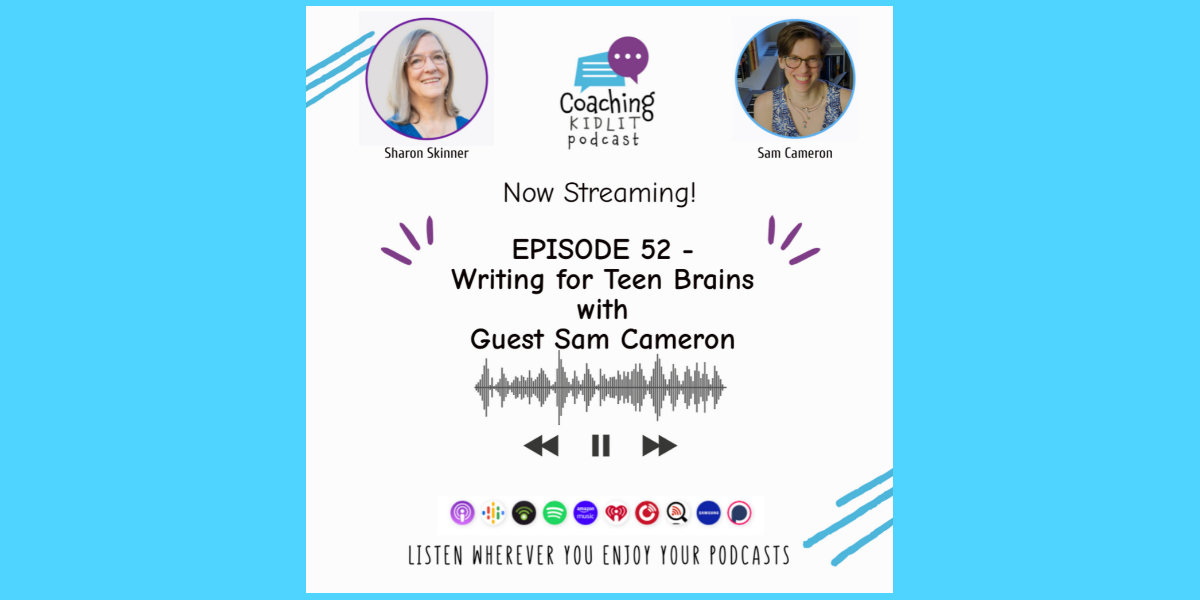
Coaching KidLit Episode 52: Writing for Teen Brains with Guest Sam Cameron
In this episode of Coaching KidLit, Sharon Skinner welcomes back former high school teacher, book coach, and writer Sam Cameron to delve into the intricacies of writing for teens by understanding the teenage brain. Drawing from her teaching and coaching experiences, Sam explores how teen brain chemistry affects their curiosity, need for agency, and intensity of emotions. The discussion covers techniques for ensuring teen characters drive the story, the importance of presenting authentic interiority and emotional experiences, and strategies for preventing adult characters from overshadowing teens in kid lit narratives.
Connect with Sam Online:
Website: https://truantpen.com/
Substack: Truant Pen
Instagram
Topics Covered
- The unique chemistry and development of teen brains and its impact on reader engagement
- The importance of agency for teen and kid characters in fiction
- How to structure stories so teens—not adults—drive the action and consequences
- The power and role of strong emotions in YA and MG
- Techniques for showing emotion and interiority on the page
- Using sensory detail and visceral reactions to deepen emotional resonance
- Leveraging stakes and difficult choices to propel character growth
- Practical strategies to reconnect with the teen mindset as a writer
- Actionable steps for analyzing scenes to ensure character-driven decisions
Books Mentioned
Date Me, Bryson Keller by Kevin Van Whye
The Sunbearer Trials by Aiden Thomas
Dune by Frank Herbert
Game of Thrones by George R. R. Martin
Collars and Curses by Sharon Skinner
Listen:
Transcript:
[00:00:28] Hello listeners, this is Sharon, and this month we’re welcoming back Sam Cameron.
[00:00:34] Sam is a Formula One fan and writer of queer Love stories. She put these two passions together and now she writes queer Formula one rom-coms based on Shakespeare plays. After 10 years as a high school history teacher, Sam shifted gears to become a book coach and freelance editor.
[00:00:52] She’s the author of the weekly Substack Truant Pen, where she shares actionable advice for stuck writers. And we’ve had Sam on the show before, but she offers so much rich information. We had to have her back. Welcome back, Sam.
[00:01:05] Sam Cameron: Thank you so much. It’s wonderful to be back with you.
[00:01:08] Sharon Skinner: I always enjoy our talks. And today we’re gonna dig into a fascinating topic that really gets my little nerd brain going. We’re gonna talk about teen brains.
[00:01:17] Sam Cameron: We are, we are gonna talk about teen brains.
[00:01:20] Sharon Skinner: Sam, this is a great topic and I’m really excited to dig into it, and I think you probably have a lot of knowledge to share. Having been a history teacher you were teaching teens, right?
[00:01:32] Sam Cameron: Yeah.
[00:01:33] Sharon Skinner: so being a history teacher at that level, you’ve interacted with a lot of teens over the years, and I imagine that’s what inspired you to dig into this topic.
[00:01:43] So tell us a little bit about that.
[00:01:44] Sam Cameron: Yeah, so over the course of my teaching career, at the time I was writing a lot more Ya now I’ve kind of shifted towards adult. But I still work in my coaching practice with a lot of Young Adult writers and I realized that, , there were some things that I had learned about how to make my classes engaging and accessible to my teen audience that could maybe play into what writers need to think about when they want to make their books accessible to teenagers.
[00:02:12] So this included me thinking about things like what’s going on in teen brain chemistry. And how that’s a little bit different from adult readers or younger children. This got me thinking a little bit about vocabulary development because I know that’s a really big issue, that writers are thinking about when they’re writing for kids is how to create something that is at the correct level for kids who are doing the reading.
[00:02:38] But also. Doesn’t talk down to them. Because kids are very sensitive to that. They know when they’re being pandered to or talked down to, and they, really don’t like it. So from kind of thinking about that, there were a couple of points that I sort of landed on. So one important takeaway that I learned, , is that this should come probably as no surprise to anyone who spent any time with a teenager, but teenagers are easily bored.
[00:03:00] And so your books have to really pack a punch and pack interest right out of the gate. Teenagers are naturally curious. They are naturally in a phase of life where they want to experiment and test boundaries. And so books are a chance for them to explore autonomy they don’t otherwise have in their real lives.
[00:03:18] And so agency is something we talk a lot about in writing, but it’s I think especially important when you’re writing for kids to make sure that you have. Child characters and teen characters in the driver’s seat. and then kind of the last point is that teen emotions are very powerful, which I think most of us remember from our teen years.
[00:03:37] and that actually has to do with the same exact reason why teenagers are easily bored, actually makes their emotions more powerful. And so. That sort of like leads to the idea of it’s really important to get emotions and powerful emotions on the page for teen readers.
[00:03:51] Sharon Skinner: So those are a lot of the things that I see a lot with the manuscripts that come to me. And not just for kids, but across the board. A lot of writers struggle with Initially when you’re writing, having a character have agency, for example, and not give them the answers and not have another character offering up the answers, or, being too spot on with their guidance.
[00:04:15] share with us, some of the techniques that you recommend that we use to ensure that our characters have agency.
[00:04:22] Sam Cameron: so agency just refers to the ability of a character to have an impact. On the world around them and, the ability of a character to move a story forward. And so when I think about agency, I actually like to think about Hamlet, because Hamlet is famously this very indecisive character.
[00:04:42] You know, that’s kind of the whole point of the story, is that we have this indecisive character who has to make decisions. and despite being indecisive, Hamlet actually has a lot of agency because he does make decisions that move the story forward. so if, you remember from when you read Hamlet he’s basically called upon to. Avenge his father’s death. and he’s feeling really uncertain about if he should do that. But instead of just being uncertain, in which case there wouldn’t be much of a story, he makes decisions to try to make himself more certain, right?
[00:05:17] So he makes the decision to, invite, a group of actors to come put on a play. Imitating the way in which his father was murdered in order to determine how his uncle reacts and to see if his uncle is guilty, before he’s ready to make the decision to move forward of actually avenging his father’s death.
[00:05:35] So in order to create a character who has agency, it’s first important to have a clear goal for your character, something they want. Establish stakes for why they want it, right? Why is this something they have to have now and then to show the character making decisions that brings them towards that goal.
[00:05:55] Even if they’re flawed decisions, in fact, it’s probably better if they’re flawed decisions that are gonna move the character towards the goal. And the other really big key thing is not only showing, so a character has a goal. They have reasons for wanting that goal. You show them making a choice, taking an action that is in pursuit of that goal.
[00:06:16] And then the last important piece is making sure that action has consequences. That’s also a part of agency is making sure that the actions of the character have real consequences.
[00:06:26] Sharon Skinner: And even deciding to not make a choice or deciding not to act is choice. and that can be a choice that comes with its own consequences. I don’t want us to sound like you have to force your characters to make a choice. Sometimes deciding, oh, I, can’t decide, I’m not gonna make a choice, can be problematic as well.
[00:06:46] Especially at that age. You know, if you are faced with a choice as a young adult or a teenager. And you just can’t decide, but you really are supposed to make a choice. You really are in a position where you need to make a choice and you choose not to choose. That can have big consequences at that age.
[00:07:05] Sam Cameron: Oh yeah, absolutely. I think that’s a good point that deciding to not decide, depending on what type of story you’re writing can actually be really effective. I’m a big fan of the Save the Cat plotting model. I think there’s lots of other good ones out there. I happen to like Save the Cat and if you too, are also a fan of Save the Cat.
[00:07:23] There’s this part of. The, structure where the main character has been presented with a catalyst, right? Or some sort of problem that’s gonna force them out of their comfort zone. And there’s a whole beat that’s called the debate beat. And that is the type of place where your character might very well decide, I’m gonna ignore this problem, or I’m gonna try to ignore this problem.
[00:07:45] I’m going to kick the can down the road, and then something will happen that will make them realize they actually can’t. Or they have to make some sort of different decision. They can’t ignore whatever the problem is.
[00:07:55] Sharon Skinner: Yeah, that call to adventure that we see and that sometimes the characters have to be pushed into or given another reason to go for it and move ahead.
[00:08:07] Sam Cameron: And that’s where the stakes piece comes in. The stakes are basically why does the character want what they want? What do they think will happen if they get it? What do they think will happen if they don’t get it? Why do they have to go after it now? Why can’t they wait until it’s more convenient?
[00:08:23] And what else could they be doing instead? And why can’t they do, those other things? How is the story pushing them essentially into a corner?
[00:08:31] Sharon Skinner: Yeah. So we’ve pushed our character into a corner. We’ve forced them forward and given them enough agency to make a choice. And then we have consequences and those consequences set up a new situation that forces another choice.
[00:08:46] And that cycle continues throughout the story as we move ahead. So one of the big problems that I see in, a, lot of the manuscripts that come to me, especially for young adults and middle graders, is when adults. Play too big a role and give the characters the answers or are too spot on with their guidance and the characters are not having to make these decisions themselves and not having to figure it out for themselves.
[00:09:15] Do you see that as well.
[00:09:16] Sam Cameron: Yeah. and I actually have a couple of examples of books that I think handle this really well. So there’s a sort of, I think a joke within the KidLit world is that, you know, the. Parents are always like dead or absent in some way. And there’s a good reason for that, which is that it forces the kids to be in the driver’s seat.
[00:09:33] And so I think that there’s like a little bit of pushback, in the idea of, wanting to show supportive adults, like models of like what supportive adults look like, wanting to, write books where the main character isn’t an orphan, like I understand all of that. And so I came up with some examples of books where there are actually living parents and or supportive adults, but something about the situation that the teenager is in means that they actually can’t rely on those adults for help.
[00:10:03] And that would be a really good way to structure your story, without having to have. the main character be an orphan, although you could do that as well, right? that does work. So the examples I was thinking of, the first one is a contemporary rom-com called Date Me, Bryson Keller by Kevin van Whye.
[00:10:19] And the main character, Kai has two alive, involved and loving parents. But Kai is gay and he’s closeted and he isn’t sure how his parents are going to react to his sexual orientation. He has reasons to believe that they wouldn’t be all that. Happy about it. , And most of the plot revolves around Kai secretly dating another boy who is also questioning and closeted.
[00:10:41] and so as the story conflict escalates, Kai doesn’t feel like he can involve his parents because it would mean coming out to them, which he doesn’t feel ready to do. So that would be, I think, a really common way. To, push teen autonomy is even if you have supportive, loving, involved parents to basically give the teen something that they’re doing, that they feel for one reason or another, they can’t involve their parents in, which is also like very realistic and believable because teenagers a lot of times don’t wanna talk to their
[00:11:12] parents, even if their parents would helpful.
[00:11:14] Sharon Skinner: Yeah, I, think that in most of my books, . It’s either that the teenager or youngster Isn’t willing to talk to their parent or is angry at their parent or has a conflict with their parent. Even though the parent is truly there and supportive and loving, the kid isn’t seeing it because that’s common.
[00:11:31] we feel misunderstood when we’re kids. We feel misunderstood, especially when we’re teenagers, like, well, they’ll never understand. They don’t know what I’m going through. You know, that sort of thing. Teenagers especially get pretty wrapped up in that and they don’t know how to. Trust and speak to their parents a lot of times, or they’re not willing to, or they don’t wanna give away someone else’s secret.
[00:11:53] I think in your, example, Kai probably doesn’t wanna give away the secret of the person he’s dating either, because that wouldn’t be Okay. So there are a lot of reasons that teenagers keep secrets, embarrassment, fear, all these things. And just the idea that, they’re old, they’ll never understand. They don’t get me, right.
[00:12:12] Sam Cameron: Yeah, o r even like, another common one is a natural sort of developmental place where teenagers are, is they’re at the place where, they are experimenting with who they are and how they’re gonna be in the world. And so there’s frequently a conflict. In real life between teenagers and their parents or teenagers and other adults in their life of a teenager wanting to prove that they can do it by themselves.
[00:12:36] And so they might intentionally not involve an adult because they have some reason why they’re trying to prove that they’re capable. so this is where the stakes piece can come in, is your teenager has some sort of goal. And they believe that they can’t involve their parents because there’s something they want, like they wanna go to sleepaway camp or they wanna get their driver’s license, but they can’t get that thing unless they’ve proven that they can be trusted to do something on their own.
[00:13:05] And so as their conflict gets more and more dire, they might think like, oh, I could. Go involve my parents, but if I do that, then I’m never gonna get the sleepaway camp or the driver’s license or whatever it is, so that would be another way to, very organically make it clear why the teen character has to stay in the driver’s seat and doesn’t want to involve their other adults.
[00:13:26] Sharon Skinner: And that’s a really good point that you also need to present the, interiority of the teenager when they’re thinking that we need to see and. Understand why they don’t involve their parents as we go along. So we need on the page, the information of that interiority, that thinking, that decision making process so that we as the readers are Yeah, I get it.
[00:13:50] Maybe I don’t agree with why they’re behaving that way, but I get why they’re doing it.
[00:13:55] Sam Cameron: Yeah. And ultimately, I think that’s the point reading, right? Is that we’re looking at situations we aren’t in, and we’re thinking about what would I do? What does this person do? How does it feel to be this person? And do I understand why they’re doing what they’re doing?
[00:14:08] Sharon Skinner: Right. And then when comes agency, the other piece of that is that we wanna see how someone else would get through a situation like that so that we know how it can be done, how it can be handled, how that can be managed. And we don’t have to go through it ourselves because we’ve. Basically Brainwise experienced it because a character that we’ve been engaged with has gone through it, and I love that about brains.
[00:14:34] Sam Cameron: Yes. And actually that brings up, an important mechanism that’s going on in everybody’s brain, but I think is especially salient for teen brains. Which is that when you read a really good book, or watch a good TV show, you get a release of dopamine in your brain. And dopamine is this neurotransmitter that basically rewards you for doing things that are necessary for survival.
[00:14:56] By making it feel good. So things like eating carbohydrates, we need carbohydrates to survive, right? And so our brain rewards us for that behavior by flooding us with all these feel good neurotransmitters. And the same thing is actually true for stories as you were hinting Sharon the whole point for us, probably the whole point evolutionarily for reading and engaging in stories is to rehearse and learn.
[00:15:21] About scenarios we haven’t encountered, but also like to learn social information about how to fit into the world, which for teenagers is like really critical. Like that is the biggest thing they’re trying to figure out. , But also teenagers have a naturally lower baseline level of dopamine in their brains than adults or younger kids do.
[00:15:42] So that’s why everything feels really boring to them. It’s also why their emotions feel really powerful. It’s why they’re more susceptible to depression and anxiety, but it also means that they’re like really susceptible to a good book if they find one. And that’s gonna give them all of those little rushes of, dopamine.
[00:15:59] Sharon Skinner: Yeah, and it’s, why teenagers do some of the crazy things that they do.
[00:16:02] ‘Cause they’re seeking that dopamine high. They’re seeking ways to raise that dopamine to a level that makes them happier.
[00:16:10] Which is why I did a lot of the things I did when I was a teenager that were not wise, let’s put it that way.
[00:16:16] So that’s a really good point. And, you know me, I love talking about brain science and I love talking about all of that. But I also wanna get into, how we can then.
[00:16:27] Make sure that these books are engaging and that we are doing what we need to do in our stories to engage teens in those stories. And you mentioned emotion on the page, which to me is super key. And I see a lot of stories that come my way where the author just. Can’t quite, or it hasn’t quite yet gotten emotion out on the page, the interiority at a level where we can really access what’s going on with that character.
[00:16:59] And again, back to brain science, if we get access, we experience the story, we get not just the dopamine, release, but we actually experience the story or, the journey ourselves. So what are some of the ways that you like to make sure emotion gets on the page?
[00:17:17] Sam Cameron: So that’s a really great question. So a, a common issue I see, and I actually saw this in my own writing. The other day I went back to reread. A book that I shelved a couple of years ago that I’m thinking about starting up again, and I was totally guilty of this exact problem, that this is a big part of why this book wasn’t working.
[00:17:33] So the, issue I think is that many writers understandably misunderstand the advice of show don’t tell. And what I often see is that. Writers treat the narrator of their story as if their narrator is a camera. And so all they are doing is describing to us what is exteriorly visible, to, a outside observer.
[00:17:56] I know I’ve done this. Have you seen people doing this, sharon?
[00:17:59] Sharon Skinner: I see it a lot. And one of my areas of genius is getting emotion on the page and getting mood and tonality on the page. to enhance the accessibility and The emotion of a scene. so I work with a lot of writers who come to me with that exact issue and also those of us who are able-bodied have a tendency to use sight.
[00:18:23] and sound what the characters can see and what they can hear. And we don’t rely on our other senses in our writing. And just adding sensory detail through character Lens can add a whole level of emotion on the page for a scene. And I’m not talking about just five senses.
[00:18:41] I am also talking about. the gut sensations, all of the things that go into those sensory details that you can add to. And that’s the other thing too, is you, talk about the narrator on the wall. We get that narrative distance when you say she was sad, Right?
[00:18:57] Or she cried big fat tears. that. Doesn’t really engage me. That doesn’t pluck at my heartstrings. But if you show me how she’s really feeling and sensing the world around her at the same time, now I’m starting to be there.
[00:19:15] I’m right in it.
[00:19:16] Sam Cameron: I’m really glad you brought up sensory detail ’cause that actually relates directly to the exercise or the recommendation I was going to give. So this is a really cool trick that’s deceptively simple and I think really effective. That is called a reaction progression. And I originally learned this from, Emily Golden and Rachel May of Golden May editing, and they have a great podcast called Story Magic.
[00:19:39] So the idea of a reaction progression is that it mimics, a real world way that we move through the world and process and, make sense of the world. And it’s also a very simple way to kind of check to see if you are putting, emotion on the page and also decision making, which is what we talked about when we were talking about agency before.
[00:20:00] So the way that this, reaction progression works is it mimics how we move through the world, which is that we encounter an external stimulus, right? We’re constantly bombarded with stimuli. And those stimuli can be sound, they can be sight, but they can also be tastes and smells. A fun little.
[00:20:17] Other like brain science thing is that smell is most directly related to memory out of any of our senses. So the example I’m about to give uses smell. So the, character encounters an external stimulus. They then have a physical or an instinctive. Bodily reaction. Their, physical body responds to the stimulus, which then leads to internal processing.
[00:20:37] So the, character makes sense of what the physical response means, which would include any relevant memories or backstories that the stimulus brings up. And that then leads to an action or a decision. The character does something as a result of the stimulus and their reaction to it. So the example I have of this is, I used to live across the street from an Ikea and my Ikea, I don’t know if this is universal to ikea’s the basement, like when you’d go to check out, just smelled like cinnamon rolls.
[00:21:06] So my example of a stimulus is the smell of freshly baked cinnamon rolls at Ikea, right? The physical involuntary reaction is your stomach growls. Internal processing, you realize you’re hungry, but also the smell of the cinnamon rolls reminds you of Christmas morning when you were a kid. You and your sister used to help your mom make cinnamon rolls on Christmas Eve.
[00:21:26] They’d rise on the counter overnight and your mom would put them in the oven in the morning. So by the time you finished opening presents, they were fresh cinnamon rolls, ready to eat for breakfast. Thinking of this makes you miss your mom who has passed, and also your sister who you’ve been fighting with.
[00:21:40] Decision slash action. You buy some cinnamon rolls even though you were planning to wait for your sister to apologize. First, you realize the two of you need to have a conversation and a peace offering might help. You’ll bring the cinnamon rolls to her house this afternoon.
[00:21:53] Sharon Skinner: That’s a great process for helping writers walk through this, and I love the example And I also love the physical reaction because I talk all the time about visceral. Visceral is so key in getting emotion on the page and getting sensory detail on the page.
[00:22:10] So it’s not just about what you smell, what you taste, what you touch, but that visceral sensation of, your stomach growling that’s, that interior ception, which is about the interiority of what’s going on in your body, and you notice your heartbeat or you notice your stomach growl or your body’s doing things that you’re not controlling, like the hair standing on end.
[00:22:32] Those are visceral reactions and very physical, and we miss those. A lot in our writing, especially when we’re early drafting. When we’re first drafting, and those are things that can be layered in. So it’s not something that you have to worry about during first draft. It’s definitely something that can be layered in as you go along.
[00:22:51] But I love the reaction progression idea, because that is a way to actually lay in some of that groundwork while you’re writing.
[00:22:59] Sam Cameron: Yeah, and it, it’s super helpful for me. So I use this technique all the time and like Sharon said, you don’t have to do it all at once. So like, physical reactions are really hard for me to think of in the moment. And so in my early drafts, there’s a lot of like, so-and-so’s stomach clenched, or their heart sped up or whatever.
[00:23:16] It’s, there’s not a lot of diversity in what their physical reactions are, just because I have trouble remembering how do people’s bodies react to certain situations. so I like to go and look at the emotion thesaurus.
[00:23:28] It’s Becca Puglisi and Angela Ackerman, the emotion thesaurus. When I’m writing, I, consciously will think about like, okay, I know I should put in these reaction progressions, and.
[00:23:38] Sometimes I’ll just go ahead and put in the same physical reaction over and over again, even though I know I’ll have to revise it. Or sometimes I’ll even just put a placeholder, like I’ll say, physical reaction, tk, and I’ll come back and do it later. So yeah, you can absolutely layer these things in, but just the conscious decision to put in reaction progressions, really is gonna help create.
[00:24:02] A draft that has more of the emotion on the page to begin with.
[00:24:06] Sharon Skinner: And that can be really helpful. And I do see the same. Thing in a lot of the work that I edit and that I coach is we see the stomach clench, the heart pound, and those become very cliche. Not only are you saying it a lot, but we’ve seen it a lot. And those are great placeholders. As you said, you can put a placeholder in or you could put in a standard physical feeling or sensation, but.
[00:24:31] Look for those later. Those are places where you can level up your game. You can level up your prose. You can really find something more specific and not just specific so that it’s not cliche, but something specific to your world and your character and the lens through which they view the world. So I work with a lot of speculative fiction, in particular science fiction and fantasy.
[00:24:56] You’ve done all this wonderful world building, why would you have your character see that world through A real life? like here where we are at Lens, they live in that world. They would see the world through that, lens, and they would describe things in a way that makes sense in that world.
[00:25:14] So I coach my writers all the time. If you are writing a world that is a water world, then the. Physical sensations that your character will have often can relate to water, right? That’s the kind of thing that’s really gonna level up the prose and the engagement.
[00:25:33] Sam Cameron: Yeah. And I think if you’re talking about fantasy, I really love when, ya fantasy writers use the magical abilities of their characters as a, way of showing sort of their. Emotional state. or having an emotional relationship between the character and their magical abilities. One example that’s popping into my head right now is, the Sun Bearer trials by Aiden Thomas.
[00:25:56] The main character has wings, and the main character is transgender and has body dysphoria about his wings. And so, you know, that’s something that. The author really kind of plays with throughout the story is the physical sensations of these bound wings and how the character feels about his wings and, and everything related to that.
[00:26:17] Sharon Skinner: In my book, Colors and Curses, my character is a shapeshifter, and so a lot of times I’m connecting that because she doesn’t feel comfortable in her own body. She’s a lot going on with figuring out who she is in the world, and part of it is that she doesn’t feel like she fits into her body So I use that a lot with the shapeshifting and also the lack of control.
[00:26:42] because teenagers are always being controlled the, collar in the title is a shock collar that her mom uses to keep her from wolfing out. And that’s totally a dead on metaphor for how we feel as teenagers, right? We feel collared, we feel like we’re being controlled, and our parents are trying to do it from the best place.
[00:27:03] Usually but it doesn’t feel that way when you’re a teenager.
[00:27:06] Sam Cameron: Yeah. And also I think, you know, a lot of teenagers have, this sort of sense of like, why don’t I feel the way that I used to? Like, why does my body feel different? Why do my emotions feel different? and so using magic as like an extension or a metaphor of that is something that I think is really compelling.
[00:27:21] Sharon Skinner: Well. The neurological hookups that are happening in the teen brain with all of these new connections that are happening and then, dying away and then happening again. it’s like they’re totally being rewired.
[00:27:34] Sam Cameron: They are. Yeah.
[00:27:35] Sharon Skinner: and, That is an uncomfortable place to be. I remember being that teenager where, you know, my brain was a wreck.
[00:27:43] I made bad decisions, very often, and I didn’t always know why I chose to do the things I did, but I’m sure I had justification for every single decision I made.
[00:27:53] Sam Cameron: Yeah. Well the other thing that’s like really amazing about teen brains is so teen brains are very highly plastic. so plasticity in neuroscience is the ability of a brain to change and adapt and create. New pathways, like Sharon was just saying. And teen brains are really highly plastic and teenagers are going through more development than they have since they were toddlers. and it’s just that we don’t think teen development is cute or sweet the way that we think toddler development is. so I mean, if you think about it, you know, the average teen on any given day is learning a new language, learning calculus, learning world history, learning how to drive, learning how to navigate their friendships, all while having.
[00:28:33] Their sleep schedule was totally thrown off by their changing brain chemistry, having their interests totally change. so it is a, wild and remarkable time to be alive.
[00:28:44] Sharon Skinner: And to get through. so writing for teens can be really tricky, and one of the things that. Makes it easier for me is that I think I got stuck, right around that age. in my maturity level, my emotional level, I remember what it was like very, very distinctly to be that age. It’s very easy for me to slip in to that mindset and that kind of, that brain, which is, I don’t know, it’s, I don’t think that automagically happens for most people.
[00:29:13] So what kind of. Recommendations do you have for people who wanna write for teens who maybe are not able to slip back into that mode as readily?
[00:29:22] Sam Cameron: Oh, that’s a really good question.
[00:29:24] So one would be to, and I’m sure you’ve given this advice many times, Sharon, is to of course read in, the genre. and to not just like read in the genre, but really kind of sync into, Other types of teen media, so like watch the TV shows that are targeted towards teens, especially if you can figure out which ones are popular.
[00:29:44] It’s a little hard to know sometimes because, stuff that is targeted for teens is often really popular with adults. so if you’re looking at teen TV shows on Netflix or whatever streaming service, and you’re looking at ones that are popular, it’s hard to know like which ones are.
[00:30:00] Just popular with teens, right? Or if there’s some that are meant for teens, but really it’s adults that are watching it. But you know, kind of figure out, what books and TV shows are kind of popular with teens. Read and watch them look for what some of the patterns are. I think it’s also useful to do some sort of reflection on your own experiences as a teenager.
[00:30:22] So think about what books did you really like when you were a teen and you know, maybe even reread them and try to think about why did this appeal to me when I was a teenager? Because teens also like books for adults. Like, I really remember liking Dune when I was a teenager. My students recently were also really enjoying Dune.
[00:30:41] I wouldn’t say that’s typically a YA book even though the main character is a teenager. but it does resonate with a lot of teenagers, game of Thrones, something that a lot of teenagers enjoy, even though it’s definitely not a teen book. So kind of think about, what were you reading as a teenager?
[00:30:56] Maybe go back and reread it and try to think about, you know, putting yourself back in that space. Like why did it speak to you? Why did you like it? If you were so lucky to have written. anything that you have written as a teenager. so if you kept a diary, if you have some of your old school papers, if you have letters that you wrote to somebody, anything that can kind of help you reconnect to who you were as a teenager and your teen self.
[00:31:20] That’s potentially really helpful if you have teen children. I know that they’re probably not gonna want to talk to you because teenagers, as we discussed, don’t often wanna talk to their parents, but they also are very oblivious to what adults can hear. Like I think teenagers think adults are, not able to hear them.
[00:31:35] And so like if you’re carpooling, like driving the carpool for your kids, they’ll talk about all sorts of stuff with the other kids that are in the back as if you’re not there. and you can learn a lot about kind of what they’re thinking and, what they’re feeling from that, even if your kid doesn’t want to talk to you about, very deep stuff that’s going on with them.
[00:31:53] So those, I think are all, some, little ways that you can try to tap into, those teen feelings and, remind yourself what, that’s like.
[00:32:01] Sharon Skinner: Yeah, and maybe, find some aromas that will remind you maybe there are some aromas that will bring back some of those memories and help you to get into that mode And if that’s the case, then maybe get a candle or some incense or whatever that aroma is, and fill your room with it when you’re writing those scenes.
[00:32:19] Sam Cameron: Yeah, or like if you have siblings, or friends from when you were a teenager that you’re on good terms with, you can actually just talk to them about like, what do you all remember? so I’m actually married to someone that I went to high school with. And so we don’t often talk about Our memories of high school, but we do, occasionally something will come to us like, oh, do you remember that thing, or that teacher, or, whatever.
[00:32:40] and so it’s by coincidence, I’m married to someone that I went to high school with. My two brothers went to the same high school. My wife’s brother went to that high school. My older brother’s wife went to that high school. So it’s just like, there’s a lot of people that I can talk to who knew me in that time period, and or who had.
[00:32:58] Some similar experiences ’cause they lived in the same town and went to the same school. and then obviously like the fact that I was around teenagers every day, all day, every day for 10 years. That helped me a lot. but yeah, like try to connect with the people who were teens with you and just talk about your memories, and try to trigger some of those
[00:33:14] memories.
[00:33:15] Sharon Skinner: That’s a good point. So we are at the point in the discussion where it’s time for us to give our listeners some action items. So Sam, what action item do you have for our listeners today?
[00:33:26] Sam Cameron: So I’m gonna share with you a little test that you can do to check if you have agency for your teen narrator. In your story. so the first thing you’re gonna wanna do is you’re gonna wanna make a list of all of the scenes that are in your story. And for each scene that you list, you want to make a list of the choices that the main character makes.
[00:33:54] and like Sharon said. Choosing not to act is also a choice. pay particular attention to any of the choices that move the story forward, or have consequences. So once you’ve done that, once you’ve made this list of what are the scenes, what choices are being made in every scene, if there are any scenes where someone other than the, teen main character makes the pivotal decision or takes the pivotal action, look for a way to revise the scene so that the main character is the one who makes that decision instead. And also something to think about when you’re making this list of the decisions, think about how do the choices that the main character’s making reflect the internal struggle that they’re facing and the point that you’re trying to make with the story.
[00:34:37] So the choices shouldn’t be something that’s totally random. They should be something that is relevant to. Both the story goal, right? What it is that the character’s going after, but are also relevant to, the character arc, So if you have a teen who is on, a journey of, believing in themselves, How do the choices reveal the extent to which they are or are not believing in themselves?
[00:35:02] That’s my action item. So list, out every scene in the book. Make a list of choices that the main character makes. If the pivotal story moving decision is being made by someone else, try to give that choice to your character instead, and look for ways to make those choices relevant to the story goal and the character arc.
[00:35:20] Sharon Skinner: And also when they’re making those choices, they shouldn’t be simple and easy. They should be difficult choices. Wherever possible, and as you go along, the choices have to get harder because the consequences become bigger as you move the story along, and that’s how you progress your character into that arc.
[00:35:39] Sam Cameron: Yes. And I’ll also add, if you come across a scene where there is no choices being made, you actually don’t have a complete scene, that is a crucial element in any scene is that the main character makes a choice that moves the story forward. If you’re missing that your scene is actually an incomplete scene.
[00:35:56] so that is a good indicator that some revising needs to happen there.
[00:35:59] Sharon Skinner: That’s a great action item. I think that’ll be very helpful for a lot of people to make sure that their characters have agency throughout the story because that is a big one that we see is not enough character agency, especially in middle grade and YA my action item for our listeners is to, as you go through that exercise, also look at, for every scene.
[00:36:21] What’s the point of the scene? Why does it matter to the character? Because that’s really important. And then. Wherever you’re going through your story, whenever there’s an action that your character takes, ask yourself, why? Why are they doing this?
[00:36:38] Why are they making this choice? why is this happening now? Because what I see a lot of times is that we’ll see a scene that. Doesn’t have, as you said, Sam, a purpose, and I’m asking why. Why are we seeing this as the reader right now? Why is this happening right now? Why is the big question, so ask yourself, why am I having this scene happen?
[00:37:01] Why is this taking place right now, and why does it matter to the character?
[00:37:06] Sam Cameron: And I think especially because the word counts have to be shorter for ya and middle grade compared to adult books, like that’s a crucial question no matter what. But it’s, especially important with KidLit where you have these shorter word counts.
[00:37:18] Sharon Skinner: absolutely. Yeah. Sam, it’s always great to talk to you and we could go on all day, especially about brain science because I could geek out on this totally. But we do need to keep our episodes at a listenable length, and so I’m gonna ask you now, where else can we find you online?
[00:37:37] Sam Cameron: So if you’re interested in learning more about writing for teens, if you go to my website, truant pen.com/teen, I have a free workbook for authors, that goes through. All of the most important points that I’ve brought up about teen brain chemistry and shares exercises like the ones that I’ve shared with Sharon about, making your book more appealing for teens.
[00:38:02] So that’s one place is truantpen.com/teen to get that free workbook. And then you can also subscribe or follow my substack truant pen.
[00:38:11] Sharon Skinner: Thank you, Sam for being here. It’s always a pleasure.
[00:38:14] Sam Cameron: Thanks so much for having me, Sharon.
[00:38:16] Sharon Skinner: Bye for now.
[00:38:17] We hope you’ve enjoyed this episode of Coaching KidLit, a writing and book coaching podcast for writers who want to level up their KidLit game. For more episodes, visit coaching KidLit dot com and to find out more about what a book coach could do for you, visit my website, book coachingbysharon.com.
***
Follow us on Instagram and Twitter: @CoachingKidLit
For more information about Sharon Skinner, visit bookcoachingbysharon.com or follow her on Instagram @sharon_skinner_author_bookcoach
***
Want to know more about working with a Book Coach on your KidLit book? Check out my KidLit Coaching Page or fill out my inquiry form to schedule a FREE Consult call and let’s get started!
Keywords: kidlit, writing craft, book coaching, authorial intention, superpowers, community, critique groups, author visits, children’s books, middle grade fiction, narrative nonfiction, character development, plot, revision, publishing journey, sensitivity readers, school visits, truth in fiction, heart in writing, feedback, strengths and weaknesses, manuscript connections, action items, poetry, layering elements, creative process, connections, genre, writing flow, writing passion