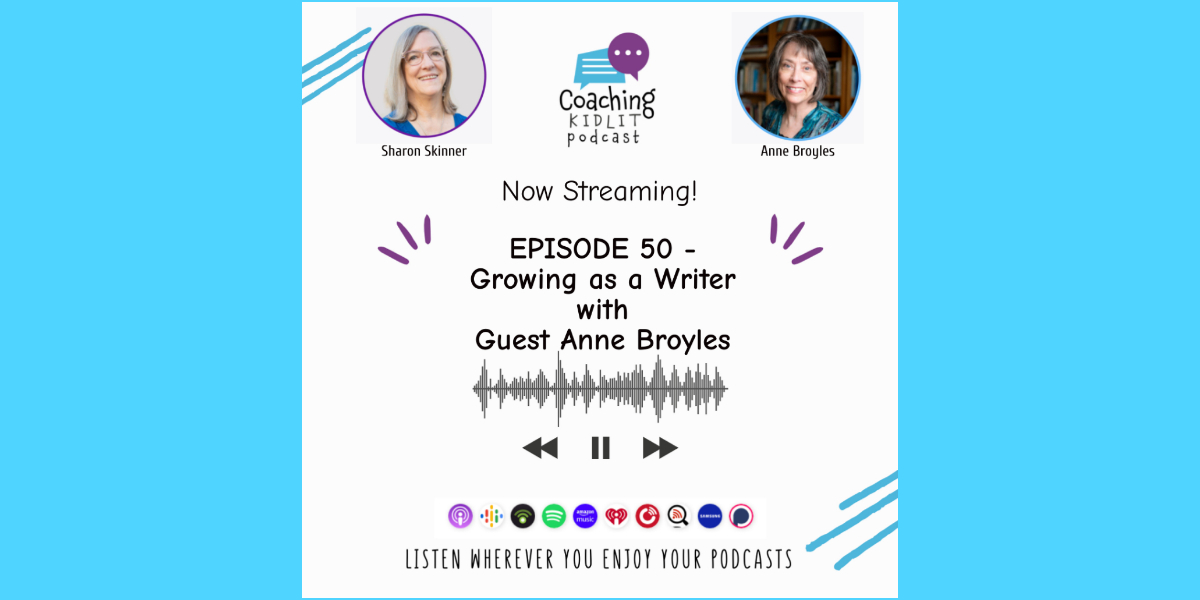
Coaching KidLit Episode 50: Growing as a Writer with Guest Anne Broyles
Host Sharon Skinner chats with acclaimed children’s author Anne Broyles about her writing journey, growing as a writer, and the importance of perseverance. Anne shares insights on writing across genres, working with editors, and her latest nonfiction book, “Eating to Save the Planet.” They discuss the lifelong process of improving craft, finding community, and why patience and resilience are essential for kid lit writers. Actionable advice encourages writers to keep learning and never give up on their publishing dreams.
Connect with Anne on Social Media:
IG: annebroylesauthor
Bluesky: @annebroyles.bsky.social
Topics Covered
- Getting Started in Kid Lit
- Navigating Rejection and Perseverance in Publishing
- Developing Craft and Working with Editors
- Research and Writing Nonfiction for Kids
- The Importance of Writing Community and Critique Groups
- Lifelong Learning
Books Mentioned
I’m Gonna Paint by Anne Broyles, Illustrated by Victoria Tentler-Krylov
Priscilla and the Hollyhocks by Anne Broyles, Illustrated by Anna Alter
Eating to Save the Planet by Anne Broyles, Illustrated by Hannah Li
Shy Mama’s Halloween by Anne Broyles, Illustrated by Leane Morin
Arturo and the Navidad Birds by Anne Broyles, Illustrated by KE Lewis, Translated by Gust Soanish
Arturo and the Bienvenido Feast by Anne Broyles, Illustrated by KE Lewis, Translated by Maru Cortes
Words Spoken True (pub date: 12/1/26 with Scholastic) by Anne Broyles
Listen:
Transcript:
Sharon Skinner: [00:00:00] Welcome to coachingkidlit.com, a podcast about writing and publishing. Good KidLit. We dig into various aspects of writing craft through a KidLit lens and provide inspiration and clear actionable items to help writers like you move forward on their KidLit writing journeys. I’m Sharon Skinner, author accelerator, certified book coach and author of Speculative Fiction and KidLit, including picture books, middle grade and young adult.
Hello listeners, it’s Sharon again, and this month we have Anne Broyles. Anne is an acclaimed children’s book, author of picture books, middle grade books, and young adult novels, a world traveler, a vegan cook, and a Cherokee Nation member. Her most recent books include the picture book biography. I’m gonna paint with four star reviews, and priscilla and the Holly Hawks, a Bank Street, college Best Children’s book of the year. But today we’re going to talk to Anne [00:01:00] about one of her newer books called Eating to Save the Planet, welcome, Anne.
Anne Broyles: Thank you so much. I’m glad to be here.
Sharon Skinner: So Anne, you are writing across age categories, you’re writing across genre. Tell us a little bit about your writing journey and how you became a Children’s book author and how your passion draws you to the different projects that you work on.
Anne Broyles: well, I started out writing adult nonfiction and published that for many years, and like a lot of other KidLit authors, I had kids. And then started having ideas, of course, reading more children’s literature and decided I wanted to write for children. And so at that point, fairly early on I joined S-C-B-W-I.
So I would get some of the tools that I needed. And we may touch on this later, but I did not, find that all my non-fiction for adult writing skills transferred easily to KidLit. ’cause it’s a totally, totally different genre as we know. And. So then I started writing books for kids [00:02:00] and the most embarrassing but sweet moment was I wrote a book.
I thought it was a book. It was sort of like a lame short story. But I had a friend who was a TV producer who had met Tomie dePaola. So I sent Tomie dePaola my lame little story, this is before I joined SVWI and said, would you like to illustrate my book? So this is how ignorant I was of the whole process. And that sweet man wrote back a note that I still have that basically said, oh, I would love to illustrate your book, but I’m booked up several years in advance, and instead of saying to me.
how dare you contact me. This is not the way the business works, and this story doesn’t even go anywhere. He did it in a way that kept me going. and then when my first book was called Shy Mamas Halloween, and I read in an S-C-B-W-I newsletter, the Kind who, we still got paper copies. And it said that there was a publisher in Maine that was looking for books on.
We weren’t using the words diverse characters or anything then, [00:03:00] but whatever they wanted. I thought, oh, this book about, a Russian immigrant family’s first experience of Halloween could work. So I sent it, I mailed it on a Thursday. On the following Tuesday, I got an offer
To publish that book. they ended up publishing it in one year because one of their employees who worked in the accounting office, really loved it and wanted to try illustrating a book, and they gave her time to do that. So I was set up with totally unrealistic expectations. Oh, you can send a book off.
It gets accepted right away. It gets published right away, and that has never happened. In that way since then. But that gave me the confidence then to really jump into it. Not full-time, ’cause I still had to make a living. But, I was able at some stage then to join S-C-B-W-I to get into critique group, to start going to workshops.
And little by little I got the skills that I needed to really publish all of the books that I have published.
Sharon Skinner: I love the story about Tomie. Tomie was a [00:04:00] beautiful soul and one of the kindest people I’ve ever met. did you ever get a chance to go to any of the conferences and meet him?
Anne Broyles: I did not, you know, the closest I got was being a Facebook friend, which is not very close, but it, sort of like I got to get some of that sweet soul, that kindness, that generous spirit. I got that, from a distance, but no. Didn’t meet him in person
Sharon Skinner: he would’ve loved to have known. I don’t know if you ever shared that story on Facebook with him, but he would’ve loved to have heard that his kindness led to you continuing on and getting published.
Anne Broyles: I think it’s part of what has influenced me. It’s who I am as a person anyway, but I do think as I have, been asked to critique other people’s work in workshops, et cetera, I really try to make sure that they are left with hope.
Even, if I think this, particular work will never get published, I want them to have, enough encouragement that they don’t give up.
Because I feel like everyone, or at least most everybody, if they work hard enough, could get something
published.
Sharon Skinner: Yeah, we start from, a place that we don’t know what we’re doing and sometimes [00:05:00] some of us, like I’ve been guilty of it myself, when I first wrote my first very bad. Middle grade novel. of sending it off too soon and thinking, oh look, I wrote a book and, and it really wasn’t a book yet.
it had some great elements, but it was not a complete story and not what it could have been and what it is now that I learned how to go back and fix it many years later. So it got thrown in a drawer for a while and then I learned how to write. A novel and was able to go back and fix it, but we get excited and, we don’t know what we don’t know.
it’s a lovely story though, because Tomie was so kind to you and encouraging.
Anne Broyles: Yes.
Sharon Skinner: Okay. So then you got that unrealistic expectation from that first book, and then that had to be tempered a bit, I assume, with your subsequent books.
Anne Broyles: it did. I ended up getting an agent and was with her for, I think, six years. She only, got one of my books, purchased in those six years, so I did not stay with her, but That at least gave [00:06:00] me more of a writing community in terms of having agent mates, and it also then gave me somebody else’s input other than my critique groups.
I think critique groups are really, really important, especially in the early years, for most writers. There may be some who don’t need that, but I certainly learned and grew a lot. And then my second book, ended up. Being rejected first by the editor. but she said, I like so much about it but this, doesn’t work for me.
And so my agent at that point said, would you like to rewrite it for her or would you rather just have me look for other editors? And I said, I. She already likes some of it. Let me work on it. That was in October. I couldn’t figure out what to do with it until something like February or March when one day I woke up and thought, oh, I think I’m gonna work on that.
And then I got it in better shape, sent it to her, and then she purchased it. but that still ended up being a several year process by the time, it was, published.
Sharon Skinner: So in that instance, you got [00:07:00] feedback on the things she liked. Did she also give you feedback on the. Things that she had trouble with, is that how you were able to sit down and figure it out, or did you just have to do that on your own?
Anne Broyles: She gave me enough. I don’t know about you, Sharon, but a lot of times, especially in my earlier years, I would get feedback and I would have that defensive reaction that. I still see in a lot of young or newer writers, you know, like, wait, you just don’t understand it.
that’s not what I said. Well, of course, often we haven’t put in what we needed to put in, and I think that was more, I needed to just flush out some parts and maybe delete some other parts and then by the time that she accepted it. It needed almost no revisions except for one page. There was one spread that the copy editor, what had gone all the way to copy editing, and then the, copy editor said, this doesn’t make sense.
And so we, probably spent off and on several days back and forth trying to rewrite those few words on those pages and then I think it ended up
being perfect. Luckily
Sharon Skinner: And that was a picture book.
Anne Broyles: that was [00:08:00] Priscilla and the Hollyhocks, which is based on, true history.
Sharon Skinner: So that is again, a long-term process that we go through, and especially in the KidLit industry, especially with picture books, it does take a long time and we think it’s done. It’s only 500 words. I did my best. I made it, super polished. And then we get editorial feedback that we have to.
Deal with, and this is one of the reasons why writing a picture book is very difficult too, because you still have to say what you wanted to say and get it out and articulate it in a way that works for the story. But you have such a small space to do it in. And it’s even harder, with rhyming picture books because you still have to have the rhyme scheme and the same number of syllables and the same rhythm But you still have to tell that part of the story in that couplet or that line or what have you.
Anne Broyles: That sounds really hard. I don’t write poetry, so I, admire people who can do it well.
Sharon Skinner: so after you did the edits for that and [00:09:00] that was published, then what was the next step for you?
Anne Broyles: So I left my agent and then began sending things out on my own and talk about a long process, let’s just say that my two books, my two Arturo and the Navidad Birds and Arturo and the Bienvenido Feast, which are English, Spanish, bilingual picture books. I sent them and I didn’t hear back from an editor for two years and I assumed that that person hadn’t taken it.
And then two years later it’s like, is that book still available? And then that person ended up publishing two of my books. But there’s a lot of having to wait. I tend to work on multiple projects. So like in that case I just, sent that out. I didn’t get much response, so I went on to something else and then was able to do.
Those books and then I had like a long period between agents. I queried 61 agents over. Maybe six, eight years and didn’t even hear from most of them. And some of them said, let me see more, and then I didn’t hear from them. It’s very easy to [00:10:00] feel ghosted in this industry, I think, like, oh, hello, I’m here.
you acknowledge me, once, or you didn’t. And, during that time, I worked on a body of work, so that I had a lot of things to sell and then I was able to get my new agent a couple years ago. And the book that’s coming out next year was Scholastic. She sold
pretty quickly for me.
Sharon Skinner: And what’s the name of that book?
Anne Broyles: Words Spoken True, and it is a young adult historical novel, the true story of a young Cherokee woman named Jane Bushyhead, who survived marching on the Trail of Tears in
1838.
Sharon Skinner: Wow. That’s gonna be an amazing story. I, look forward to that.
Anne Broyles: I think it’s the best thing I’ve written, but that remains to be seen since it’s not published till next year. We’ll find out what
other people think
Sharon Skinner: Well, it’s the one thing I always say is that we always are a better writer today than we were yesterday. So we always are improving our craft. So it probably is, the best thing you’ve written.
Anne Broyles: well hopefully. And the other thing [00:11:00] is, it just shows, don’t give up. If you can’t handle resilience and perseverance, then you need to be in a different field, because rejection’s just part of everyday life. And you can’t every time say, oh, they hated my book.
I can’t do this anymore. Or you say, I can’t do this anymore. It’s not how I wanna spend my emotional energy. And that’s. Find something else. But if you really wanna make it in children’s literature, you have to know that rejects just part of what happens and learn from that rejection if possible and move on.
Sharon Skinner: perseverance pays as, we say.
Anne Broyles: Good.
Sharon Skinner: yeah. Now you have written a book called Eating to Save the Planet, how Veganism Helps Fight Climate Change. And this is an illustrated book. It’s not a picture book. It’s more of an illustrated chapter book, it’s, nonfiction. So talk a little bit about what moved you to go in that direction.
Anne Broyles: Well, my, editor for the Ralph Fasanella book. with Holiday house, we had a [00:12:00]brainstorming session one day, which I had never had an editor do before. It was wonderful. And we were talking about different things that I might wanna write about and they might wanna publish. And somehow, you know, she asked me about doing a book on climate change and I said, I’m not a scientist.
No. There’s so many people who would do that better than I would. And then we talked some more and I. talked about Albert Schweitzer and how he was one of my heroes and what are the reasons I’m vegan. And then she said, would you like to write a book about veganism and climate change? And at first I said, no, not really, but I thought about it during our conversation and I thought.
As a vegan and as a social activist, this was a chance for me to, learn more on my own and then to write a book that I have hoped is not preachy, but it’s just conversational. And I consider it a chapter book ’cause it’s 125 pages and it does have chapters and has very minimal. illustrations, but I think the illustrations really make it bright and lively and some of the graphs and things that, Hannah [00:13:00] Lee, that illustrator did, just make it more fun, to read.
So then I had to spend a lot of time, a lot, lot of time during all the research because yes, I could have written the parts about how do you become vegan? What do you eat? What’s the lifestyle like? I could have done that with no research, but. Trying to tie it into climate change.
I wanted to make sure it was scientifically correct and provable evidence that took longer because I didn’t have as much information in my brain to attach it to. ‘ cause again, I’m not science-based. I’m still not science-based, but I feel like I mostly know this, part of the subject, don’t ask me everything about climate change, but how factory farming relates to climate change. I hopefully know a lot about that.
Sharon Skinner: Well, I think you do now because I learned so much reading this book that. I was really surprised because I had an inkling of things like how cattle and methane works and how the waste gets into the system. I had an inkling, you really dug into the details and made it very [00:14:00] specific and honestly kid friendly in so many ways, including the idea that a cow can poop out something my size in a day.
I had no idea that a cow could poop out 150 pounds in a day. I mean, I knew that they were putting out waste, but I had no idea the level of it. And of course, kids love poop. So there you go.
Anne Broyles: Yeah, I, haven’t had any other. Chapter headings. I think that be any book before that say something like, let’s talk poop. but you know, definitely, and I try to say the cows can’t help it. That’s just who they are. They poop and they, burp and, that’s how their systems are made.
And I don’t think they were ever intended. To be crowded into a space with thousands of other cows it is the number of, cattle that makes the difference. You know, farming just is almost nowhere anymore that the farmer has. Two milk cows and, that’s all, So it’s the way that beef is raised in the United States in particular, but in other developed countries, [00:15:00] as well that are really negatively impacting the climate. I just wanna say I actually learned more than I put in the book because I thought my editor said, it needs to be at least 125 pages.
I wrote 175 and then she said. No, it can’t be more than 1 25. So whole chapters, whole sections were, deleted or just little bits of them put in other places. And like, one of the parts I really wanted to keep was about deforestation. For instance, the Amazon, a lot of the reason we’re having problems and that the Amazon is struggling is cattle farming down there?
So I learned a lot too, and I tried to not. Overwhelm people with how much I had learned, but enough that they could, understand what the problem was.
Sharon Skinner: and I think that you did a great job with that, and I, couldn’t tell that you had cut large swaths out. The Continuity was solid for the book, and we went from subject to subject in a way that made sense for my brain, and I found it to be very kid friendly, as well as very informative [00:16:00] for someone like me who clearly thought I knew more than I know,
Anne Broyles: don’t we all?
Sharon Skinner: About this topic and I think that that’s the case often. Yes, you’re correct. we do that. But I mean, I thought I had an idea and there was a lot to this about the big factory farms that I was not aware of. And what concerns me is, the lack of regulation and the loosening of regulation around that because that just makes it worse.
Anne Broyles: Absolutely. I just wanna give absolute credit to my editor, Della Farrell at Holiday House because she took those 175 pages and then made some broad suggestions. I cut, cut, cut and tried to get it down, and then I kept saying, I’m not sure if this is the order it should go in. I’m not sure if this is where this should be.
It was a kind of a mess. I think and she really, really worked hard to help make it flow in a good, way. So I’m gonna give her all the credit for that.
Sharon Skinner: Well, a good editor is worth their weight in [00:17:00] gold. I have an editor who really makes my work shine and I like to do that for other. Writers. I think working with an editor is a really important part of the process. So tell us a little more about your experience about working with editors.
Anne Broyles: Well, other than the one editor that didn’t get back to me for, two years and, didn’t give a lot of guidance, I’ve had really excellent editors. I believe, Shy Mama’ s Halloween had almost no editing. On it. So again, my first book, unrealistic Expectation, Priscilla, that was Yolanda Leroy Scott at Charles Bridge.
what I liked about what she did, I had like, single space, a couple pages saying ideas about what could be changed or questions, but she did it in a way, and Della does this as well of saying. This is your book. You make the decision, but why don’t you think about. Paring this down, or maybe you might wanna expand this part a little bit or [00:18:00] could this be clearer?
And so I think, an editor who asks good questions is, what works for me. I’m not a person who likes to be told what to do in many things, but I want the book to be the best book it can be. So I’m gonna listen to an editor. It’s the reason I would never self-publish because I feel like an editor is what makes.
The book you use the word shine, and I think that’s, absolutely true. So I’m now working with a new editor for the book, at Scholastic. And I love how much she loves my book, and it’s a long book, so she’s already read it several times, you know, and, she appreciates it and she gets it.
She can still say, can you gimme a little bit more of this relationship here or there? And the first revision, when she sent that to me, I’m like, oh really? There’s not enough. And I looked and I had like left a main character out for five chapters. Well, no, there wasn’t enough there. And she was right. But all she did said was, say that general thing.
And then I went back and filled in the gaps. So I think most. All the editors I’ve worked with are really good. They know what [00:19:00] they’re doing, and I’m just grateful for all of their
comments.
Sharon Skinner: I think number one, something you mentioned that is really critical to me is authorial intent and knowing. From what you’re reading from the writer, what they’re trying to get at, so that you can help them get there and get it out of their head and heart and onto the page when maybe it’s not quite there.
Like you said, maybe they’ve left somebody out in the cold for too long during the story or that sort of thing, and I think pointing that out and asking those questions like, wait, what? What happened to so and so? Or Might you consider doing this That is a very nice and gentle way to have an author think about their work and think about whether or not maybe it isn’t on the page.
Because we do think that, well, I got that done, you know, I got that done. I still have that knee jerk when I first get feedback of, but I got that done. I did that. Right. And so like you were talking about earlier. I always have to [00:20:00] sit with the editorial feedback I get, and I know that I have to sit with it to get comfortable with it and then let it bubble up into, oh, that’s what they’re talking about, or, oh, that’s what’s missing.
So I think it’s really important to get that kind of feedback on your work. Now I use, beta readers early on before it ever goes to my editor so that I can get some of that feedback and some of the continuity issues and things like that worked out before my editor even gets it.
But even once it gets to my editor, we got work to do.
Anne Broyles: I think that that’s just the reality that the editor can see things differently than we can ’cause we made us be too close to at least some of our projects.
Sharon Skinner: Well, and I think also when you’re writing something longer, like a novel that you are. Writing this thing, and then you may have multiple versions of it in your head because you’ve drafted it, and then you may have revised it a few times, and then which story is on the page may be a little bit elusive because [00:21:00] we have so many versions of it in our heads.
And having someone else read through and see the actual version that’s on the page and give us feedback on that is so critical.
Anne Broyles: Yes, and the, book that’s coming out next year, I started more than 35 years ago when I did not have all the writing skills I have now. And I put it away, I’d get it back, I’d put it away, I’d get it back, first person, third person, back and forth, different critique groups, et cetera. And, as I said, I think it’s good now, but there were many times.
In the past when it wasn’t as good or it wasn’t as consistent. And even on the revision that I’m working on this week, which probably is the last revision, you know, my editor caught something my whole first third, first third that I had a her instead of a she or, an I or whatever it was. Yeah, we need somebody else, we need somebody else’s eyes on it.
Sharon Skinner: Absolutely. So Anne, is there anything you’d like to cover that we haven’t touched on in our conversation at this point?
Anne Broyles: I’d like to say another word about doing this long project because one of the things [00:22:00] that’s important to me is growing as an author and. I don’t know how that happens if you don’t work at it, it’s like any other, skill. Being a quote, good writer unquote is, wonderful.
But what does that mean? So with, Word Spoken True, I. Worked on it off and on. I did it in critique groups I actually talk about an embarrassing thing. I had a meeting at HBO when this book was, now that I think of it, not really very complete and not as good as it could have been by a thousand percent, but I had a contact ’cause of where I lived in Malibu and I went to HBO and was wined and dined and they read my little sad.
Booklet or what, I don’t even know what all was in it, but it was nothing like it is now. because they were considering it for a miniseries, which would’ve been amazing. and at that point they just said, it’s about a 14-year-old Cherokee girl. They probably said 14-year-old Indian girl.
And we don’t have enough people who wanna [00:23:00] see that kind of story, which I think was true. But if it had been a more powerfully written. Complete book. they might have done something with it. So there again, I didn’t learn from Tomie dePaola in that story apparently. So. Besides going to workshops with S-C-B-W-I, which I think every children’s writer needs to do, maybe not your whole life, but for many, many years.
Not just for the learning, but for the making community and understanding what it’s like to be part of, the KidLit community. I also went to two Darcy Pattison novel revision workshops, I think 15 years apart with the same book. And it was like going to a different thing because a book had changed so much.
I went to a highlights, novel revision retreat with this book. My former agent at one point, said, you’re gonna spend more money going to this retreat than you’ll ever make from this book, which was one of the reasons. I did not remain with that person. but she maybe would’ve been right if the book had stayed the way it was.
And as it is now, I’m getting paid more by Scholastic because it’s, a [00:24:00] different book. It’s a different time. But when I think of at the end of this book, the people, I, thank it’s pages long. Because it’s all these years of me first doing research and going to national parks and going to homes and going to the Cherokee archives, all of that, and thanking those people, thanking all of the readers.
You’re talking about beta readers who read it along the way, and the one who read it say in 1990 something probably wouldn’t even recognize it except for the main character now, but. I needed to keep growing and changing and admitting that I needed more skills. in the beginning, I think the Trail of Tears was the main character.
Okay. Jane Bushyhead was in there, but I think I wasn’t into who my, protagonist was. And that took me a while to really figure out who she was and be able to write. what’s her story against the background of the Trail of Tears? And I think I do a good job of that now, but it took me years to grow enough as a writer to know how to
do that.
Sharon Skinner: I think that’s a [00:25:00] really important note that we continue to grow as writers. We continue to learn. it’s a long game. It’s a life. Long process to continue that learning because there’s always something more that we can learn or do better in our craft. Writing has so many elements to it.
Writing a good book especially and understanding the structures of the various formats. So picture book is very different than chapter Book is very different than a non-fiction chapter book is very different than a YA novel. Those formats are all very different and it takes a different skillset to really do them well.
Each of them. So I love that you talk about the growth of a writer. I think that’s really important. When I work with clients, my goal is to help them level up to the next level, right? No matter what we’re working on, whether it’s picture, book, or novel or short story, whatever we’re working on together, my intention for our time together is not only that they get a good book out of it, but that they are leveling up their skills and [00:26:00] their abilities to write the next thing.
Anne Broyles: I absolutely agree, and for me, even now, I really rely on, friends and other writers sharing their skills. Like when I was working on eating to save the planet, it was really hard to do all the footnoting and keeping track of everything. And I just called my friend Liz Rush, who’s a great non-fiction young adult writer and.
Talk through how do you do footnotes? How do you keep track of these things? And, that helped me. Or I might go to another friend and say, can you just look at these parts of my characterization? What am I missing? So I think leaning on other writers, and I think you and I both, Sharon, we know that we help, our colleagues and peers as well.
That’s just part of
being in this community.
Sharon Skinner: And when we help others, we help ourselves because we’re learning something along the way as well. So it’s, not necessarily self-serving, but it’s also growth for us as we move along.
Anne Broyles: Absolutely. It’s, very reciprocal.
Sharon Skinner: Yeah. So now we come to the point in our conversation where we offer our [00:27:00]listeners an action item. So Anne, what action item do you have for our listeners today?
Anne Broyles: Well, I would just continue what we were just talking about and say, never stop growing as a writer. Never think you know it all. and that means, as I said earlier, joining S-C-B-W-I and taking advantage of things. Once you join, there’s all these free things. Yes, you can spend money and go away for a big retreat, but you can also just do an online webinar.
SCBWI really tries to offer enough opportunities in the areas that they know most writers need help on. I think it’s important to find a critique group. maybe not for your whole life though. I know people like Jane Yolen is still in the same critique group. She’s published like 500 books and she’s still meeting with some of those Same writers, but, getting a critique group. and then you mentioned, you know, like when we help other writers, we learn too. So in your own growth as a writer may involve helping somebody else. And if they ask you a question and you saying, let me think about that, and that may be part of your growth, is to [00:28:00] say, how did I do that successfully?
Because we may not have consciously said, I did this, this, and this, but if we look at what we did, it’s like, oh, I layered the characterization in this way, or I added details in that way. Yeah, so absolutely keep growing. Stephen King is still writing, I think he writes like six days a week.
He does not need the money. He just loves what he’s doing, and my guess is he’s still trying to grow as a writer as well.
Sharon Skinner: I agree. That’s a great one. And as a lifelong learner, that one is, you know, dear to my heart to continue to learn and grow. I continue to do that. I was part of an online summit recently where I was a presenter and then I went and I was watching the videos from all these other presenters because there’s always a gem, there’s always something you can glean from how other people approach the writing and the craft, and maybe it’s something I already knew or kind of sort of knew.
Where I had an idea about it, but maybe they’re articulating it in a way that I need to hear today for whatever I’m working [00:29:00] on right now, the work in progress that I’m working on. Maybe I just need to hear it again or I need to hear it in a different way. So I think that that is a super valuable action item for our listeners.
And I’m gonna pull from something we had a conversation about, earlier on that you talked about in this process. And I’m going to tell our listeners, the action item that I have for you is be patient and persevere, because it’s the people who give up who don’t get published, not the people who keep going and hearing that you.
Queried 61 agents over a period of six plus years, and it took that time and then you finally landed another agent. that is the sort of thing that we see in the industry and especially in the KidLit industry. So there’s always room for awesome. Make sure that you study your craft and write the best book, that you possibly can, but of course, be patient and be [00:30:00] perseverant.
That is my action item for our listeners today.
It’ll pay off.
Anne Broyles: I agree. Don’t give up. Believe in yourself
and don’t give up.
Sharon Skinner: Thank you Anne . where else can we find you online?
Anne Broyles: I am on Facebook and Instagram and Blue Skies, mostly some version of Anne
Broyle’s. Author.
Sharon Skinner: Okay. And we will put that in the show notes so that our listeners can reach out and find you and follow you and connect and be part of that community that we talked about earlier. Thank you for being such a lovely guest on the show and for talking, so openly about your journey and your process.
I so appreciate having you on.
Anne Broyles: Well, thank you. I’m glad I got to know you and. And who knows when we’ll see each other at some event.
Sharon Skinner: Bye for now.
Anne Broyles: Take care.
Sharon Skinner: We hope you’ve enjoyed this episode of Coaching KidLit, a writing and book coaching podcast for writers who want to level up their KidLit game. For more episodes, visit coaching KidLit dot com and to find out more about what a book coach could do [00:31:00] for you, visit my website, book coachingbysharon.com.
***
Follow us on Instagram and Twitter: @CoachingKidLit
For more information about Sharon Skinner, visit bookcoachingbysharon.com or follow her on Instagram @sharon_skinner_author_bookcoach
***
Want to know more about working with a Book Coach on your KidLit book? Check out my KidLit Coaching Page or fill out my inquiry form to schedule a FREE Consult call and let’s get started!